
Congees
Millet and Red Date (Jujube) Congee
Millet and Red Date (Jujube) Congee is a time-honored traditional Chinese stomach-nourishing porridge, made with millet and red dates as the main ingredients, slowly simmered to perfection. It is often hailed as the "Ginseng Soup of the Common Folk" . Millet is sweet and slightly salty in taste, slightly cool in nature, and channels to the Spleen, Stomach, and Kidney meridians. It is known for strengthening the spleen and harmonizing the stomach, nourishing yin and blood, calming the spirit and promoting sleep, and tonifying deficiency. It is a staple nourishing food for postpartum women in Northern China. Red dates (jujubes) are sweet in taste, warm in nature, and channel to the Spleen, Stomach, and Heart meridians. They tonify the middle burner and supplement qi, nourish blood and calm the spirit, earning the title of "Natural Vitamin Pill." The Shennong Bencao Jing lists them as a top-grade herb. The combination creates a synergy: millet's gentle nourishment perfectly complements the sweet richness of red dates. A thick, viscous layer of "rice oil" (congee cream) forms on the surface, which is the essence of the porridge. With a golden-yellow color, rich jujube aroma, and elegant millet fragrance, this congee is creamy, smooth, and mildly sweet. It is especially recommended for long-term consumption by those with spleen-stomach weakness, qi-blood deficiency, insomnia, postpartum weakness, and post-illness recovery.
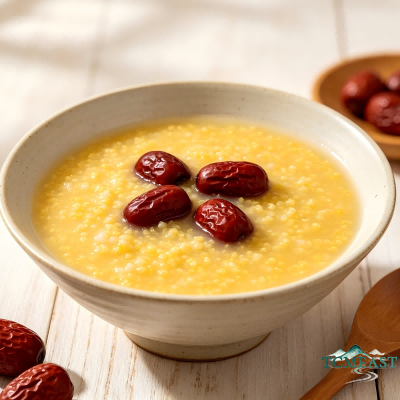
Main Ingredients
- Millet 80-100g
- Red dates (jujubes, pitted) 6-8 pieces (approx. 30g)
- Goji berries 5-8g
- Brown sugar (or rock sugar) 10-15g
- Water Approx. 1200-1500ml
Steps
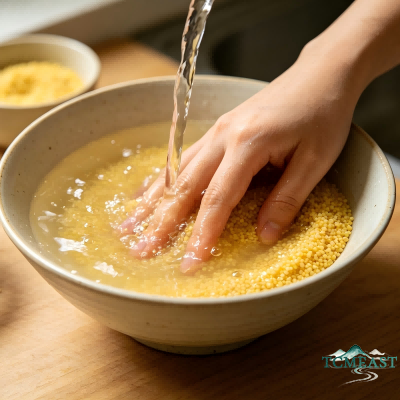
Place millet in a bowl, add water, and gently swirl to rinse 1-2 times. Never rub or wash repeatedly, as this will wash away the water-soluble B vitamins on the surface and prevent the "rice oil" from forming. Drain and let the millet rest for 10-15 minutes to absorb moisture slightly.
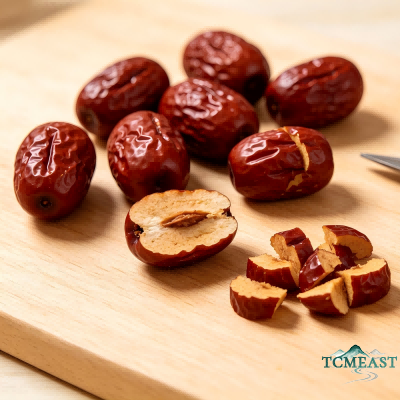
Rinse the red dates. Cut them open with scissors and remove the pits. Further cut the flesh into small strips or pieces to fully release their sweetness into the congee.
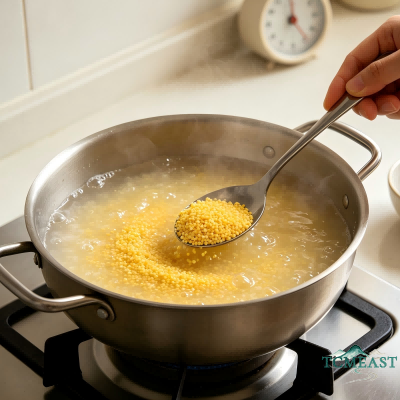
Add sufficient water (approx. 1200-1500ml) to a pot and bring to a full rolling boil.Once the water is boiling, add the drained millet. Stir quickly in one direction with a ladle to prevent the grains from sticking to the bottom. Boil over medium-high heat for 5-8 minutes (this "high heat burst" helps the grains bloom and release oil), then reduce to low heat, cover with a slight gap, and simmer for 25-30 minutes.
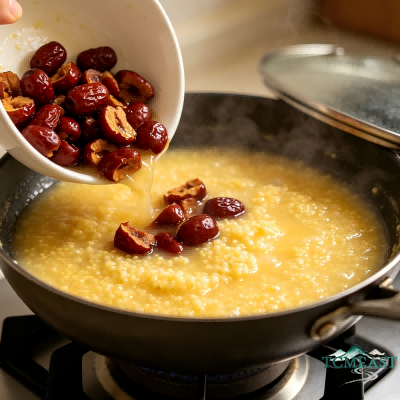
When the millet grains have bloomed and the porridge begins to thicken (about 20-25 minutes after adding the millet), add the prepared red dates. Continue simmering over low heat for another 10-15 minutes until the dates are fully softened and their sweetness is completely infused.
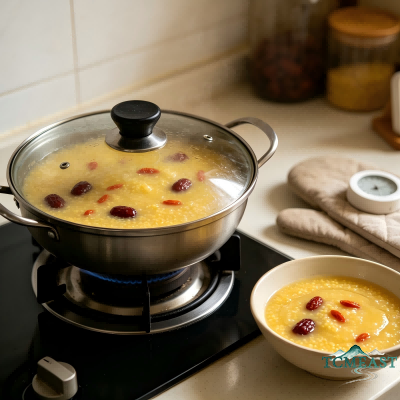
Add the goji berries 5 minutes before turning off the heat. If using brown sugar, add it after turning off the heat, stirring until dissolved (brown sugar is warming and ideal for qi-blood deficiency). Rock sugar can be added earlier to dissolve.
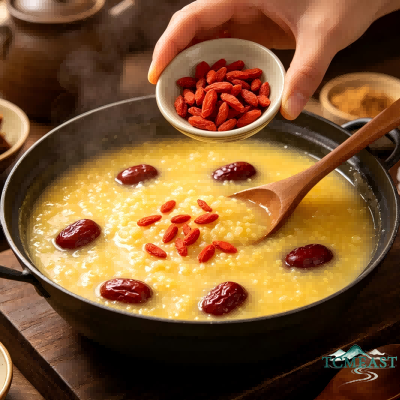
Add the goji berries 5 minutes before turning off the heat. If using brown sugar, add it after turning off the heat, stirring until dissolved (brown sugar is warming and ideal for qi-blood deficiency). Rock sugar can be added earlier to dissolve.
TCM Notes
Millet has the highest tryptophan content among all grains. Tryptophan converts to serotonin (5-hydroxytryptamine) in the body, which has calming and sleep-improving effects. Red dates are rich in cyclic adenosine monophosphate (cAMP) , a key regulator of cellular energy metabolism with anti-allergic and anti-fatigue effects. Traditional Chinese Medicine Perspective: Millet: Sweet and slightly salty, slightly cool (or cool) in nature, channels to the Spleen, Stomach, and Kidney. Strengthens the spleen and harmonizes the stomach, nourishes yin and blood, calms the spirit and promotes sleep, and tonifies deficiency. Effective for indigestion, nausea, vomiting, and diarrhea caused by spleen-stomach weakness. Red dates: Sweet, warm in nature, channels to the Spleen, Stomach, and Heart. Tonify the middle and supplement qi, nourish blood and calm the spirit, and moderate the potency of other herbs. Significantly improves poor appetite due to spleen deficiency, fatigue with loose stools, and hysteria (menopausal irritability) in women. Modern Nutrition Research: Stomach protection: The "rice oil" in millet porridge forms a protective film over the gastric mucosa, reducing stomach acid irritation — suitable for those with gastritis or gastric ulcers. Sleep improvement: Rich tryptophan converts to serotonin and melatonin, improving sleep onset and quality. Blood-building and skincare: The synergistic iron content from both millet and dates, combined with vitamin C that enhances iron absorption, effectively improves iron-deficiency anemia. Immunity boost: cAMP in red dates promotes white blood cell production and enhances immune function. Postpartum recovery: Millet is nutritionally complete and easily digestible, rich in B vitamins and iron, supporting maternal recovery and lactation.
Suitable for:Those with spleen-stomach weakness, poor digestion, and poor appetite Those with insomnia, excessive dreaming, neurasthenia, and restlessness Those with qi-blood deficiency, sallow complexion, and pale lips Those with iron-deficiency anemia and women recovering from menstruation Postpartum women, those recovering from illness, and those convalescing Middle-aged and older adults (daily spleen-stomach nourishment and constipation prevention) Infants over 6 months old — the "rice oil" of millet porridge is an ideal first food (strain out date skins and pits) Those with chronic overtime, irregular schedules, and excessive mental stress Generally suitable for most people as a daily healthy breakfast
Not suitable for:Diabetics: Millet and red dates have a medium-high glycemic index (Millet GI ≈ 71, Dates GI ≈ 55-60). Blood sugar rises quickly after consumption. Strictly control portion size (no more than half a bowl, unsweetened), and pair with protein and vegetables to reduce postprandial glucose spikes. Those with dampness excess and abdominal distension: Red dates are sweet, warm, and rich, which may cause qi stagnation and dampness retention — avoid if experiencing bloating. Those with food stagnation and severe indigestion (bloating, sour burps, heavy breath): Avoid nourishing porridges during acute episodes. Those with excessive internal heat or excess-heat constipation: Red dates are warm in nature and may exacerbate heat. Those with excessive phlegm-dampness and yellow greasy tongue coating Those with early-stage wind-cold colds or unresolved external pathogens: Not suitable for tonification. Those allergic to millet or red dates Those with dental caries (cavities): Red dates are high in sugar — rinse mouth immediately after consumption.
