
Congees
Astragalus and Chinese Yam Porridge
Astragalus and Chinese Yam Porridge is a classic traditional Chinese medicinal congee, made with astragalus root (Huangqi) and Chinese yam (Shanyao) as the core ingredients, cooked with rice or millet. Astragalus is sweet in taste, slightly warm in nature, and channels to the Lung and Spleen meridians. Known as the "holy herb for qi tonification," it tonifies qi and raises yang, secures the exterior and stops sweating, and significantly strengthens lung-defense qi to enhance the body's resistance. Chinese yam is sweet in taste, neutral in nature, and channels to the Spleen, Lung, and Kidney meridians. It strengthens the spleen and nourishes the stomach, promotes salivation and moistens the lungs, and consolidates kidney essence. Together, astragalus tonifies qi and secures the exterior, while yam strengthens the spleen and benefits the kidneys, achieving the combined effects of benefiting qi, promoting salivation, strengthening the spleen, and consolidating the kidneys. Modern pharmacological research shows that this porridge can enhance immune function, delay aging, strengthen the heart muscle, dilate coronary arteries, and improve myocardial blood supply. The congee is thick, soft, and mildly aromatic, with a gently sweet taste. It is especially suitable for daily nourishment of those with qi deficiency, spleen-kidney deficiency, general weakness, and those prone to colds.
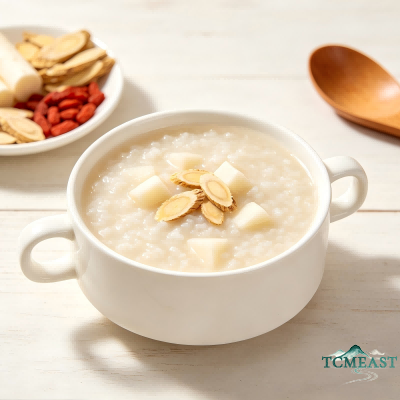
Main Ingredients
- Astragalus root (Huangqi) 15g
- Chinese yam (fresh) 50g
- Rice or millet 100g
- Red dates (pitted) 5 pieces
- Goji berries 8g
- Water 1500ml
- Rock sugar To taste
Steps
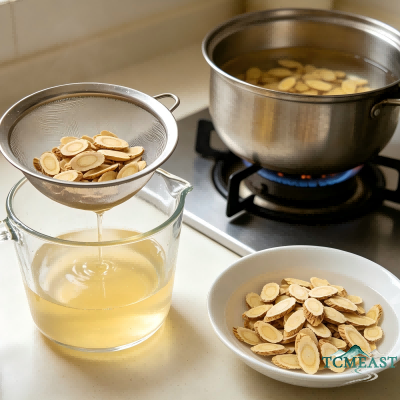
Rinse the astragalus briefly and place it in a clay pot or stainless steel pot. Add sufficient water (approx. 500-800ml) and soak for 30 minutes. After soaking, bring to a boil over high heat, then reduce to low heat and simmer for 20-30 minutes. Strain out the decoction, discarding the herb residue. Astragalus must be decocted first to fully release its active compounds.
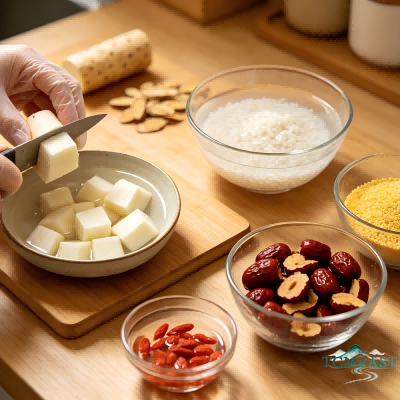
Chinese yam: Wear gloves (yam mucilage can irritate skin), peel, and cut into approximately 1 cm cubes. Soak in lightly salted water to prevent oxidation (browning). Rice or millet: Rinse and soak in cold water for 30 minutes. Red dates (if using): Rinse, remove pits, and cut into small pieces. Goji berries (if using): Briefly soak in water and drain.
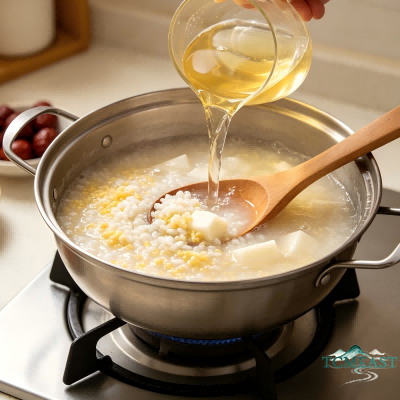
Pour the strained astragalus decoction into a pot and add enough water to reach approximately 1000-1500ml total. Bring to a boil. Once boiling, add the soaked rice and yam cubes. Return to a boil, then reduce to low heat and simmer for 30-40 minutes, stirring occasionally to prevent sticking. Cook until the rice grains bloom and the porridge becomes thick and soft.
If adding red dates, add them when the porridge is about 70-80% cooked (approximately 20 minutes after adding the rice). If using rock sugar, add it before turning off the heat and stir until dissolved.
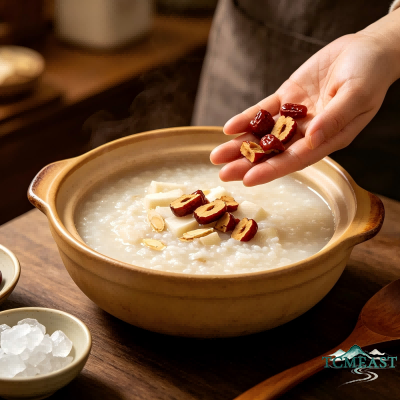
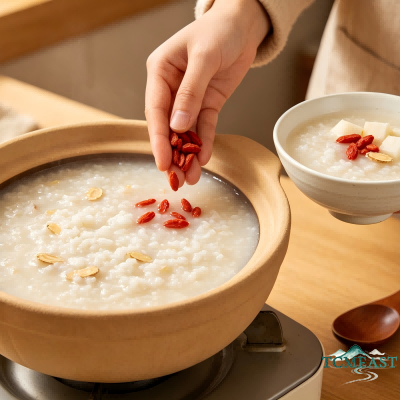
3-5 minutes before turning off the heat, add the goji berries and stir well. Turn off the heat, cover, and let rest for 5 minutes. Serve warm.
TCM Notes
3-5 minutes before turning off the heat, add the goji berries and stir well. Turn off the heat, cover, and let rest for 5 minutes. Serve warm.
Suitable for:Those with qi deficiency constitution (general fatigue, shortness of breath, breathlessness with slight activity, excessive sweating) Those with spleen-kidney deficiency (poor appetite, indigestion, sore lower back and weak knees) Those with low immunity and recurrent colds Those recovering from illness or post-surgery Those with chronic cough due to lung-spleen qi deficiency (recurrent cough, thin copious phlegm, shortness of breath, fatigue) Those with post-gastrointestinal surgery complications (adjunctive therapy) Middle-aged and older adults (daily qi tonification, spleen strengthening, anti-aging) Those with yang deficiency Generally suitable for most people as a daily wellness porridge in moderation
Not suitable for:Those with excess pathogenic factors (external wind-cold with fever, chills, no sweating, headache, body aches) — astragalus may trap pathogens inside; avoid during acute external infections Those with internal damp-heat — astragalus is warm and may worsen symptoms Those with yin deficiency and fire excess (palms and soles hot, dry mouth and throat, night sweats, flushed cheeks) — astragalus is warm and drying, which may exacerbate fire and damage yin Those with food stagnation, bloating, and sour burps — not suitable for tonification Those with early-stage carbuncles or unresolved heat toxicity Those with qi stagnation and dampness obstruction Those allergic to astragalus or Chinese yam Those with hypertension: Astragalus may raise blood pressure — those with poorly controlled blood pressure should use with caution under medical supervision Pregnant women: Especially avoid in the first trimester. Astragalus has blood-invigorating effects and excessive use may cause fetal movement issues — consume only under the guidance of a TCM practitioner
