
Congees
Winter Melon and Coix Seed Porridge
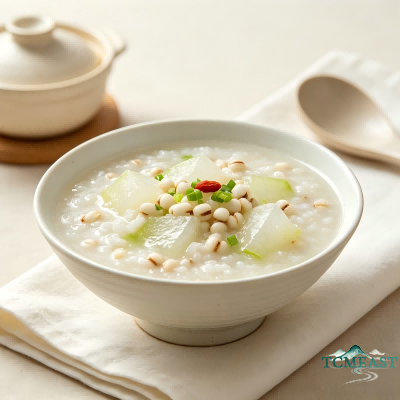
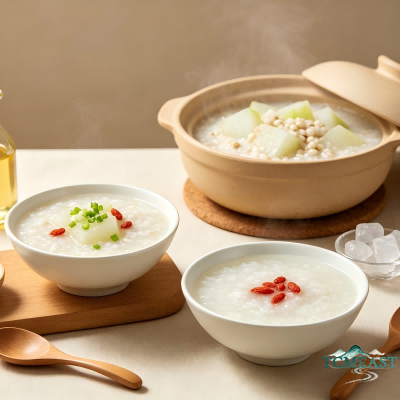
Winter Melon and Coix Seed Porridge is a classic summer medicinal porridge for clearing heat and removing dampness, particularly popular in the Lingnan region of China. It combines the diuretic and swelling-reducing properties of winter melon with the spleen-strengthening and dampness-draining effects of coix seeds, simmered with rice until smooth and creamy. The winter melon turns translucent and tender, while the coix seeds remain chewy and satisfying. Lightly sweet or savory, this porridge clears summer heat, strengthens the spleen and stomach, and eliminates excess "dampness" through urination. Ready in about 1 hour (including soaking time), it's an essential homemade wellness dish for the hot, humid season.
Main Ingredients
- Winter melon 300g
- Coix seed (Job's tears 50g
- Japonica rice (or regular rice) 80g
- Old ginger 5 slices
- Salt 3g
- Sesame oil 3 drops
- Spring onion(chopped, for savory version, optional) 1 stalk
- Goji berries 5g
Steps
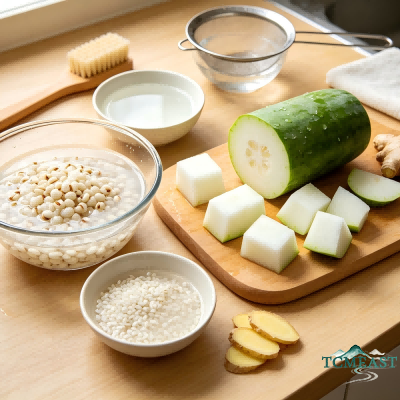
Coix seeds: Rinse 2-3 times, then soak in plenty of water for 4-6 hours (or refrigerated overnight) until the seeds visibly swell and have no hard core when pinched. This step is essential for achieving a soft, fully cooked texture. Japonica rice: Rinse and soak in water for 30 minutes, then drain. Winter melon: Scrub the outer skin clean. For maximum efficacy – cut into 2-3cm chunks with the skin on (the skin has far stronger diuretic effects than the flesh, though it's tougher). For better texture – peel the skin, remove the pith and seeds, and cut into 2-3cm thick chunks or slices. Old ginger: Wash and slice (ginger warms the middle and neutralizes the cold nature of the other ingredients).
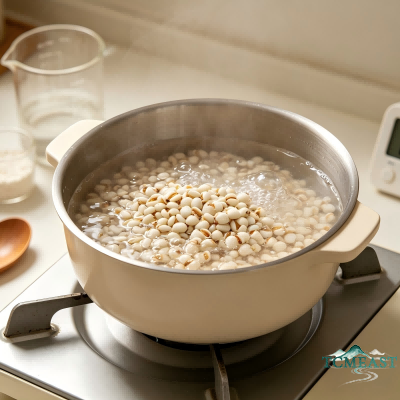
Drain the soaked coix seeds and place them in a clay pot or stainless steel pot (avoid iron pots). Add approximately 1000ml of water. Bring to a boil over high heat, then reduce to medium-low and simmer for about 30-35 minutes until the seeds are fully swollen and some begin to split open.
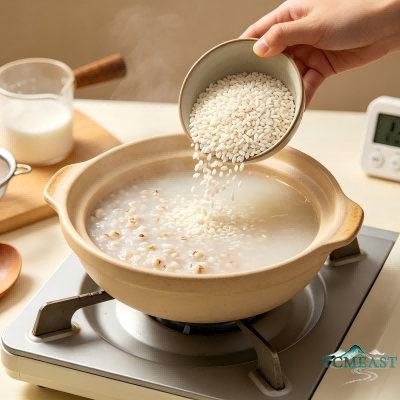
Drain and add the soaked rice to the pot. Continue to cook over medium-low heat for about 15-20 minutes until the rice grains begin to bloom and the porridge starts to thicken.
Add the winter melon chunks and ginger slices to the pot. If the water has reduced significantly, top up with hot water to a total of about 1200-1500ml (add all at once). Bring back to a boil over high heat, then reduce to low heat (maintain a gentle simmer) , cover, and cook for about 20-25 minutes until the winter melon turns translucent and can be easily pierced with a chopstick, the rice grains are fully bloomed, and the porridge is thick and creamy.
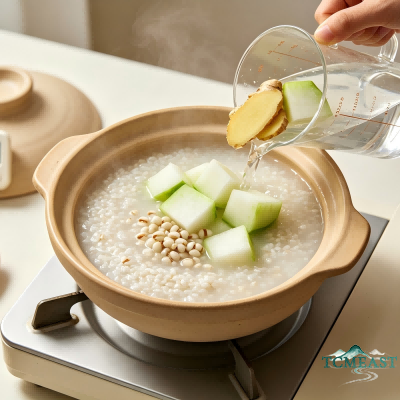
Add the winter melon chunks and ginger slices to the pot. If the water has reduced significantly, top up with hot water to a total of about 1200-1500ml (add all at once). Bring back to a boil over high heat, then reduce to low heat (maintain a gentle simmer) , cover, and cook for about 20-25 minutes until the winter melon turns translucent and can be easily pierced with a chopstick, the rice grains are fully bloomed, and the porridge is thick and creamy.
TCM Notes
Winter melon: Slightly cold in nature, sweet and bland in taste, acts on the Lung, Large Intestine, Small Intestine, and Bladder meridians. Per 100g, it contains 96.6g water, 1.1g dietary fiber, 78mg potassium, and only about 10-12 kcal. Rich in propionic acid (which inhibits the conversion of sugar into fat), trigonelline (which boosts metabolism), and various amino acids. In TCM, it is known to clear heat, relieve summer heat, promote diuresis, reduce swelling, and transform phlegm. Effective for summer heat-related thirst, edema, difficult urination, and beriberi swelling. Coix seed (Job's tears) : Slightly cold in nature, sweet and bland in taste, acts on the Spleen, Stomach, and Lung meridians. Rich in coixenolide, dietary fiber (approx. 4.2g per 100g), B vitamins, and minerals like calcium, magnesium, zinc, and selenium. Known to strengthen the spleen, drain dampness, clear heat, expel pus, and relieve arthralgia. Its diuretic effect is mild and sustained without damaging vital energy. Japonica rice: Tonifies the middle, strengthens the spleen, and nourishes the stomach – it balances the formula and neutralizes the slight coldness of the other two ingredients. Together, they achieve the effects of clearing heat, draining dampness, strengthening the spleen, promoting diuresis, relieving summer heat, and supporting weight management. One serving (approx. 300ml) provides about 80-100 kcal (savory, sugar-free) or 120-150 kcal (sweet), low in fat and sodium, high in potassium and fiber – an ideal staple for summer body cleansing.
Suitable for:Those suffering from summer heat with thirst, excessive sweating, scanty dark urine Those with damp-heat constitution, phlegm-dampness obesity, greasy tongue coating, or heavy limbs Those with mild hypertension, hyperlipidemia, edema, or lower limb swelling Those with gout or hyperuricemia (coix seed helps promote uric acid excretion) Those with simple obesity or undergoing weight management (low-calorie, high-satiety) Those with spleen deficiency and dampness excess during late summer – poor appetite and sticky stools Outdoor workers and athletes needing heat relief
Not suitable for:Pregnant women (especially first trimester) : Coix seed may stimulate uterine smooth muscle contractions – traditionally believed to carry a miscarriage risk – strictly avoid during pregnancy; this is the primary contraindication Those with Spleen-Stomach deficiency cold: Symptoms include frequent abdominal pain, diarrhea, cold sensitivity, loose watery stools, or stomach pain after cold food – both winter melon and coix seed are cold in nature and may worsen symptoms Those with dry constipation or frequent urination: Coix seed's diuretic effect may further deplete body fluids and worsen bowel difficulties Those with low blood pressure (use with caution) : Both winter melon and coix seed have mild diuretic and blood-pressure-lowering effects; consuming large amounts on an empty stomach may cause dizziness and fatigue Those with Yin-deficiency with internal heat: Symptoms include dry mouth, dry throat, night sweats, hot palms/feet – diuretic and dampness-draining herbs may deplete Yin fluids and aggravate deficiency heat Menstruating women (with deficiency-cold constitution) : Those with cold sensitivity or dysmenorrhea during menstruation should avoid cold-nature porridge Those allergic to winter melon or coix seed Caution for long-term consumption on an empty stomach – it's recommended to add warming ingredients like ginger and red dates to balance the cold nature