
Congees
Astragalus & Rice Congee (Huangqi Zhou)
Astragalus & Rice Congee is a classic medicinal porridge rooted in Traditional Chinese Medicine, classified as a gentle tonic dietary therapy. Astragalus is listed as a top-grade tonic in the Compendium of Materia Medica and is renowned as the "leader of tonifying herbs". Rice (japonica rice) tonifies the middle and strengthens the spleen and stomach, enhancing Astragalus's tonic effects. This congee is warm and sweet in nature, entering the Spleen and Lung meridians. The preparation follows the ancient "three-decotion method" – boiling Astragalus three times to fully extract its active compounds before cooking with rice. The congee is smooth and warming, with a distinctive bean-like aroma and subtle sweetness from Astragalus. This congee tonifies qi, strengthens the exterior, and promotes diuresis. It has been cherished for centuries as a wellness delicacy, as celebrated in poet Su Shi's verse: "Astragalus congee is offered at the spring banquet".
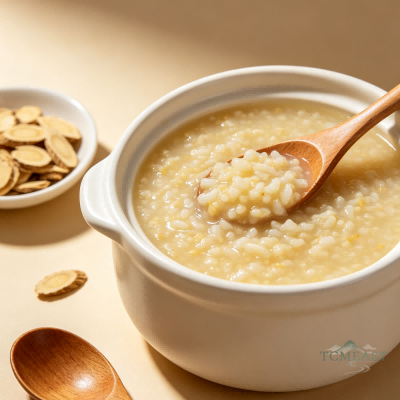
Main Ingredients
- Rice (japonica rice) 100g
- Astragalus root (Huangqi) 30g
- Water 1200ml
Steps
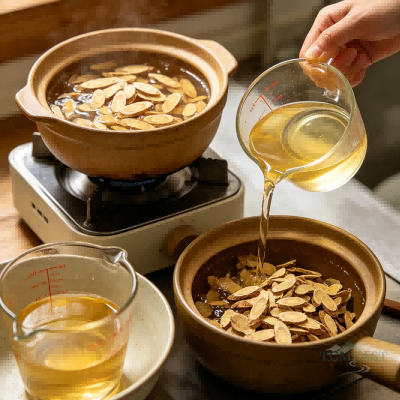
First decoction: Bring the soaked Astragalus (with soaking water) to a boil, then reduce to medium heat and simmer for 30 minutes. Strain and reserve the liquid. Second decoction: Add another 300ml of water to the herbs, bring to a boil, simmer for 15 minutes, and strain the liquid. Third decoction: Add a third 300ml of water, bring to a boil, simmer for 15 minutes, and strain the liquid. Combine: Mix all three decoctions together. Discard the Astragalus solids – they are not meant to be eaten.
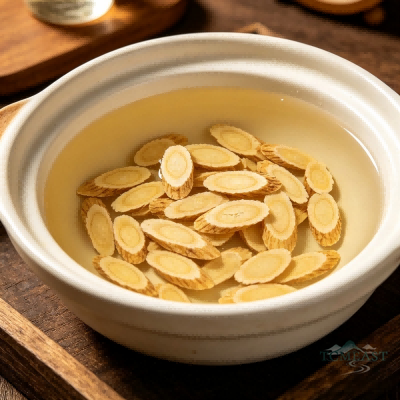
First decoction: Bring the soaked Astragalus (with soaking water) to a boil, then reduce to medium heat and simmer for 30 minutes. Strain and reserve the liquid. Second decoction: Add another 300ml of water to the herbs, bring to a boil, simmer for 15 minutes, and strain the liquid. Third decoction: Add a third 300ml of water, bring to a boil, simmer for 15 minutes, and strain the liquid. Combine: Mix all three decoctions together. Discard the Astragalus solids – they are not meant to be eaten.
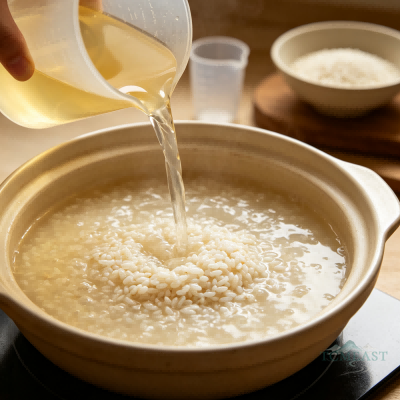
Pour the combined decoction into a pot and add additional water to reach approximately 800-1000ml total. Add 100g of rinsed rice (japonica rice). Bring to a boil over high heat, then reduce to low heat and simmer slowly until the rice is fully softened and the congee is thick (about 30-40 minutes).
Serve the congee once done. Consume once daily, on an empty stomach in the morning for best results. Take for 3-5 days as one course, then rest for 2-3 days before the next course.
TCM Notes
Astragalus (Huangqi) : Sweet in taste, slightly warm in nature; enters the Spleen and Lung meridians. Known for tonifying qi and raising yang, strengthening the exterior and stopping sweating, promoting diuresis and reducing swelling, and draining pus and generating flesh. Modern pharmacology shows it promotes metabolism, fights fatigue, lowers blood sugar, reduces blood lipids and pressure, slows aging, and enhances immune function. Astragalus is a key qi-tonifying herb, listed as a "top-grade" medicinal in the Shennong Bencao Jing. Rice (Japonica Rice) : Tonifies the middle and strengthens the spleen and stomach, enhancing Astragalus's tonic effects. When combined with Astragalus, the tonic effect becomes balanced and less likely to cause excessive heat. Synergistic Effect: Astragalus tonifies qi and strengthens the exterior; rice strengthens the spleen and stomach. Together, they achieve spleen-strengthening, qi-tonifying, stomach-harmonizing, and deficiency-nourishing effects. Total approx. 350-400 kcal, primarily carbohydrates – a low-fat warming medicinal porridge.
Suitable for:Those with general weakness, fatigue, and middle qi deficiency Those recovering from major illness, surgery, or chemotherapy/radiotherapy Those with spleen-stomach weakness manifesting as palpitations, shortness of breath, spontaneous sweating, and poor appetite Those with qi deficiency edema or summer-dampness edema Middle-aged and elderly for daily wellness and immunity enhancement Those prone to colds or sweating with minimal exertion (indicating weak lung-defensive qi)
Not suitable for:Those with excess patterns or heat syndromes – such as external excess pathogens, early-stage sores, or unresolved heat toxin after ulceration Those with yin deficiency with yang hyperactivity – symptoms include hot palms/soles, night sweats, dry mouth, irritability, and insomnia Those with colds, fevers, or sore throats – consuming during a cold may trap pathogens inside Those with liver fire excess – those who are irritable or quick to anger Hypertension patients – Astragalus may cause blood pressure fluctuations Pregnant women – should consume only under medical supervision Those with gastrointestinal stagnation – may worsen symptoms Those with allergies – discontinue if any adverse reaction occurs