
Congees
Black Bean & Purple Rice Congee
Black Bean & Purple Rice Congee is a classic kidney-nourishing and blood-tonifying wellness porridge. Black soybeans, known as the “grain of the kidney,” are black in color and enter the Kidney meridian, nourishing the kidneys, benefiting yin, strengthening the spleen, and promoting hair and skin health. Purple rice, also known as “blood glutinous rice,” is rich in anthocyanins and iron, with the effects of nourishing yin, tonifying the kidneys, strengthening the spleen, warming the liver, and improving vision. Combined with red dates to tonify the middle and nourish blood, and walnuts to nourish the kidneys and boost brain function, this congee is thick, smooth, and naturally sweet. It is especially suitable for those with kidney deficiency, prematurely gray hair, anemia, and fatigue, as well as for daily conditioning in autumn and winter.
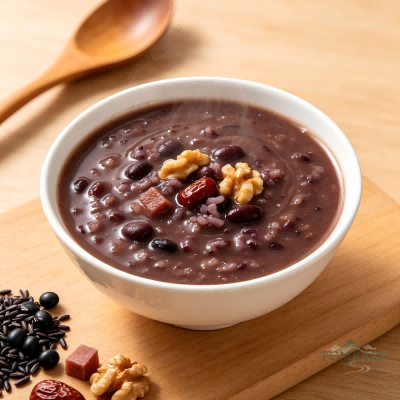
Main Ingredients
- Black soybeans 50g
- Purple rice (black glutinous rice) 100g
- Red dates (jujubes) 6-8 pieces
- Walnut kernels 20g
- Rock sugar or brown sugar to taste
Steps
Soak 50g of black soybeans in water for 6-8 hours (or overnight) until fully expanded and skins slightly split. Remove any bad beans and rinse. Rinse 100g of purple rice gently 1-2 times – do not rub vigorously to avoid losing anthocyanins. Soak in water for 30 minutes after rinsing. Rinse 6-8 red dates, remove pits, and cut into small pieces. Soak 20g of walnut kernels in warm water for 15 minutes to remove surface astringency; for a richer flavor, dry-roast in a pan over low heat for 2-3 minutes.
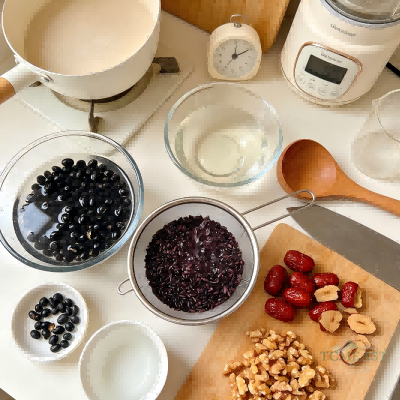
Place the soaked black soybeans, purple rice, red date pieces, and walnuts into a clay pot or soup pot. Add enough water (about 1200-1500ml). Bring to a boil over high heat, then reduce to low heat, cover with a small gap to prevent overflow, and simmer for 60-90 minutes until the black soybeans are tender, the purple rice has bloomed, and the congee is thick. Stir occasionally to prevent sticking.
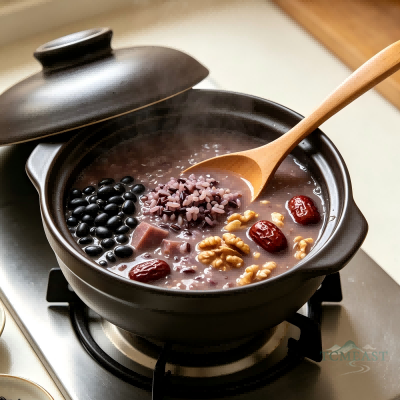
Add rock sugar or brown sugar to taste 5 minutes before turning off the heat (diabetics may omit), and stir until fully dissolved. Add rock sugar or brown sugar to taste 5 minutes before turning off the heat (diabetics may omit), and stir until fully dissolved.
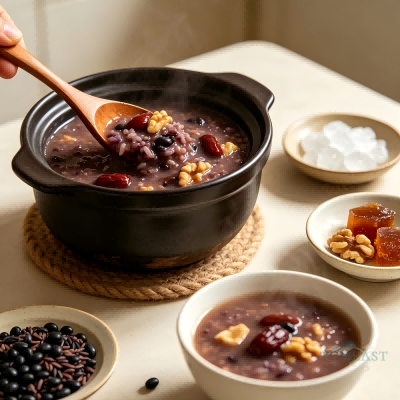
TCM Notes
Black Soybeans: Contain approximately 36g protein and 10.2g dietary fiber per 100g. Rich in anthocyanins, soy isoflavones, vitamin E, and minerals including calcium, iron, and zinc. Known for nourishing the kidneys, benefiting essence, invigorating blood, and promoting diuresis. After cooking into congee, some purines dissolve into the liquid, but the overall dish remains moderate-to-low in purines. Purple Rice (Black Glutinous Rice) : Contains approximately 75g carbohydrates, 8g protein, and 2g dietary fiber per 100g. Rich in anthocyanins, iron, calcium, zinc, and B vitamins. Known for nourishing yin, tonifying the kidneys, strengthening the spleen, warming the liver, and improving vision. The anthocyanins in the outer layer are powerful antioxidants that help scavenge free radicals and slow aging. Red Dates: Contain approximately 67g carbohydrates, vitamin C, and minerals including iron and calcium per 100g of dried dates. Known for tonifying the middle, benefiting qi, and nourishing blood. Walnut Kernels (optional) : Rich in linoleic acid, linolenic acid, and vitamin E. Known for nourishing the kidneys, warming the lungs, boosting brain function, and moistening the intestines. Synergistic Effect: Black soybeans nourish the kidneys, purple rice nourishes blood, red dates benefit qi, and walnuts boost brain function – regulating both the spleen and kidneys, and tonifying both qi and blood. Total approx. 400-450 kcal (unsweetened, entire batch), 18-20g protein – a high-protein, moderate-carbohydrate porridge rich in anthocyanins and dietary fiber.
Suitable for:Those with kidney deficiency, lower back pain, prematurely gray hair, or dry hair Those with qi and blood deficiency, sallow complexion, and easy fatigue Those with anemia, postpartum weakness, or in post-illness recovery Mental workers, students, and those with memory decline Those with constipation due to intestinal dryness (black soybeans and purple rice are rich in fiber) General population for autumn-winter wellness and breakfast pairing
Not suitable for:Those with indigestion or prone to bloating – black soybeans and purple rice are high in fiber, and black soybeans are difficult to digest; excessive consumption may cause bloating and gas Diabetes patients – purple rice is a glutinous rice with a relatively high glycemic index, and red dates are high in sugar; control portion size and reduce staple food intake accordingly Acute gout / hyperuricemia patients – black soybeans have moderate purine content; avoid during flare-ups; consume sparingly during remission, and it is recommended to discard the broth Those with renal insufficiency – black soybeans contain plant protein, and purple rice and red dates are high in potassium; portion size must be under medical guidance Those with phlegm-heat cough or yin deficiency with internal heat – walnuts and red dates are warm in nature and may promote internal heat Those with weak digestion or acid reflux – purple rice is sticky and black soybeans are gas-producing; may worsen discomfort Those in weight management – walnuts and red dates are calorie-dense; control portion size Those allergic to black soybeans, purple rice, or red dates Infants and young children – digestive systems are delicate; purple rice is sticky and difficult to digest. Small amounts only
