
Demystifying TCM
TCM Tonification Theory: Balancing Yin-Yang, Harmonizing Qi-Blood & Nourishing the Five Organs
All TCM tonification methods, from diet to acupuncture, aim to balance yin and yang, harmonize qi and blood, and nourish the five zang organs. Learn the core principles of yin-yang interdependence, qi dynamics, and spleen-kidney foundation.
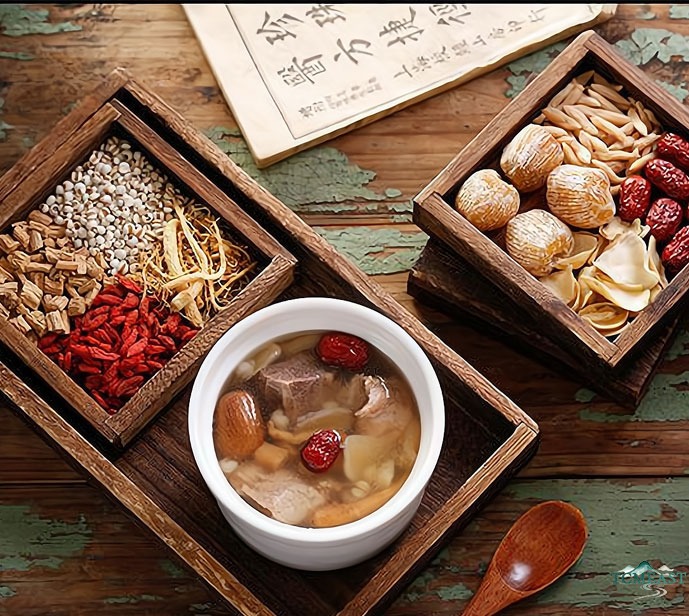
Whether it is spiritual nourishment, dietary tonification, medicinal supplementation, massage tonification, or moxibustion tonification, all are guided by the basic theories of Chinese medicine. Through their respective methods, they balance yin and yang, harmonize qi and blood, tonify the five zang organs, and regulate the spirit, thereby ensuring the health of the human body.
Balancing Yin and Yang
The theory of yin and yang is the guiding philosophy of TCM theory and continues to guide clinical practice in Chinese medicine to this day. When the human body is in a state of yin-yang equilibrium, Chinese medicine considers this to be a state of health. As the Suwen · Tiaojing Lun (Basic Questions: Treatise on Regulating the Meridians) points out: "When yin and yang are evenly balanced, thereby filling the physical form, and all nine pulses are as one, such a person is called a balanced person." When pathogenic factors act upon the human body and the body's zheng qi struggles against them, the result of this struggle disrupts the balance of yin and yang, producing a series of pathological changes. Chinese medicine refers to this as yin-yang disharmony.
Pattern differentiation and treatment is the quintessence of Chinese medicine. Tonification, as the supplementing method among the "Eight Therapeutic Methods" of TCM, should also be carried out according to the general principle of pattern differentiation — that is, applying supplementation based on pattern differentiation. Within the Eight Principles (yin and yang, exterior and interior, cold and heat, deficiency and excess) of TCM pattern differentiation, yin and yang stand at the head. The Suwen · Yinyang Yingxiang Da Lun (Basic Questions: Great Treatise on the Correspondences of Yin and Yang) points out: "Yin and yang are the Dao of heaven and earth, the fundamental principles governing all things, the origin of all change, the beginning of life and death, and the dwelling place of spirit and intelligence." In the Eight-Principle pattern differentiation system, yin and yang govern the other six principles, among which exterior, heat, and excess pertain to yang, while interior, deficiency, and cold pertain to yin.
Yin and yang are mutually dependent. The Ming dynasty scholar Zhao Yangkui, in his Yi Guan · Yinyang Lun (The Thread of Medicine: Treatise on Yin and Yang), explained the theory of yin-yang mutual dependence, pointing out: "Yin and yang each serve as the root of the other. Yang is rooted in yin, and yin is rooted in yang. Without yang, yin has no means to generate; without yin, yang has no means to transform." This means that yin essence — referring to all nutritive substances — is the material foundation for the functional activities of human physiology, while yang qi — referring to all physiological functional activities — must rely on the support of yin essence. Without the support of yin essence, physiological functional activities could not occur; and the generation of yin essence must in turn rely on yang qi for its production and transformation. Without yang qi performing this production and transformation, yin essence could not be formed. Yin and yang are mutually dependent, engendering and growing together. In the practice of tonification, one must adopt different methods according to the mutual relationship between yin and yang — whether nourishing yin, invigorating yang, or supplementing both yin and yang simultaneously — in order to achieve the goal of yin-yang balance.
Harmonizing Qi and Blood
Qi and blood are the fundamental substances that constitute the human body and sustain its life activities. Only when qi and blood are abundant can the needs of the body's life activities be met. As early as the Suwen · Tiaojing Lun (Basic Questions: Treatise on Regulating the Meridians) pointed out: "That which a person possesses is nothing other than blood and qi." Chinese medicine holds that qi has five major functions in the human body. First, qi serves to stimulate and promote the growth and development of the human body as well as the physiological activities of the various zang-fu organs, meridians, collaterals, and other tissues and organs. Second, the movement of qi maintains the body's normal temperature, thereby ensuring the normal physiological activities of all tissues and organs. This function is called the warming action. Third, qi can defend the entire body surface, guarding against the invasion of various external pathogens — thus exerting a defensive action against disease. Fourth, qi can maintain the normal circulation of liquid substances such as blood and body fluids, nourishing all the tissues and organs throughout the body.
Qi can also regulate the amount of body fluids such as sweat and urine secreted, exerting a securing and containing action on the body's fluids. Fifth, qi also possesses the function of qi transformation. The term "qi transformation" refers to the changes produced by the movement of qi, and is related to the functions of the various zang-fu organs, meridians, collaterals, and other tissues and organs. For example, the transformation of ingested food into the essential qi of water and grains, the subsequent transformation of this essential qi into qi, blood, and body fluids, as well as the mutual transformations among qi, blood, and body fluids — all are due to the function of qi transformation.
As the most fundamental substance constituting the human body and sustaining its life activities, qi performs its functions through its movement. The process of the movement and transformation of qi in the human body is precisely the process of the body's life activities.
The mode of qi movement is called the qi dynamic (qi ji). The qi dynamic manifests in four forms: ascending, descending, exiting, and entering. When the ascending, descending, exiting, and entering of qi are normal, the physiological activities of the human body can proceed normally. When these are abnormal, the body's physiological activities become disrupted, affecting human health. Abnormalities of the qi dynamic can manifest as qi deficiency, qi stagnation, qi counterflow, qi depression, qi sinking, qi collapse, and so forth. When associated with pathological changes of the zang-fu organs, they may manifest as spleen qi sinking, stomach qi rebelling upward, kidney failing to receive qi, and the like.
Blood is the red liquid circulating within the blood vessels of the human body. Like qi, it is also a fundamental substance that constitutes the human body and sustains its life activities. Blood is mainly produced through the digestion and absorption of the essential nutrients of water and grains by the spleen and stomach. As the Lingshu · Jue Qi (Spiritual Pivot: On Determining Qi) states: "The middle burner receives qi, extracts the juice, and transforms it into red — this is called blood." Blood has a nourishing function for the organism, being distributed throughout the entire body via the blood vessels and providing the material basis for the physiological activities of all zang-fu organs, tissues, and organs, thereby maintaining the normal physiological functions of the human body. Blood also provides the material basis for human mental activities. When blood is sufficient, a person's energy is abundant, thinking is clear, and sensations are acute. As the Lingshu · Pingren Jue Gu (Spiritual Pivot: On the Fasting of a Healthy Person) states: "When the blood vessels are harmonious and unobstructed, the spirit resides therein." Qi and blood share a close relationship: qi can generate blood, move blood, and contain blood.
Food and drink are transformed into the essential nutrients of water and grains, which in turn are transformed into nutritive substances and body fluids, which are then transformed into blood. None of these processes can occur without the function of qi. The circulation and distribution of blood after its generation are also achieved through the propelling function of qi. Qi's propulsion of blood circulation manifests, on the one hand, as a direct propulsive effect on the blood; on the other hand, qi's propulsive effect on the blood ensures and promotes the normal functions of the zang-fu organs, and the functions of the zang-fu organs in turn promote the circulation of blood.
Qi not only enables blood to circulate normally within the blood vessels, but also ensures that blood does not extravasate from the vessels — that is, qi can contain the blood. When the function of qi is diminished or becomes abnormal, it will adversely affect the blood. Qi deficiency leads to a decline in zang-fu organ function — for example, weakened spleen and stomach function impairs the blood-generating function, reducing blood production and leading to blood deficiency patterns. Qi deficiency can also cause sluggish blood circulation, and in severe cases may lead to blood stasis and obstruction. When qi's securing and containing function on the blood is weakened, various types of bleeding disorders will occur — this is what is meant by "qi failing to contain blood."
The various methods of tonification supplement both qi and blood, harmonizing them and promoting the body's absorption of the essential nutrients of water and grains. They ensure that qi and blood are generated in abundance and that their normal functions are maintained, thereby allowing the body's physiological functions to operate normally and safeguarding human health.
Tonifying the Five Zang Organs
Whether it is a deficiency of yin and yang or of qi and blood, the depletion of the human body is ultimately reflected in the five zang organs. Therefore, while Chinese medicine places emphasis on the tonification of yin, yang, qi, and blood, it also places great importance on the tonification of the five zang organs. The so-called five zang organs refer to the five functional organs identified in Chinese medicine based on differences in the form and function of the internal organs, and include the heart, liver, spleen, lung, and kidney. When the functions of the five zang are normal and they perform their role of storing essence, Chinese medicine describes them as "firm and strong"; conversely, when they are deficient, they are regarded as "depleted." The Lingshu · Tian Nian (Spiritual Pivot: On the Years of Heaven) states: "When the five zang are firm and strong... one can therefore endure." The Lingshu · Ben Zang (Spiritual Pivot: On the Viscera) states: "When the five zang are all firm, there is no disease." Among the five zang organs, Chinese medicine particularly emphasizes the spleen and kidney as the foundation. This is because human growth, development, and aging are all closely related to the kidney. Hence the saying that "the kidney is the foundation of the innate constitution." A good innate constitution provides a favorable material foundation for one's entire life. However, having such a foundation is not enough; postnatal regulation and support are also necessary.
Postnatal support and regulation are primarily accomplished through the spleen. Only when the spleen's transportation and transformation function is normal can the digestion and absorption of various nutrients be ensured. The relationship between the spleen and kidney is precisely that between the postnatal and the innate foundations, and similarly involves mutual support. While regulating the postnatal constitution, the innate essence qi can be continually replenished and strengthened. In other words, a person with innate insufficiency can, through postnatal regulation, transform weakness into strength. As the ancient physicians said: "From birth to old age, whenever there is innate insufficiency, if one can but obtain the nurturing power of postnatal cultivation, then the work of supplementing nature may accomplish more than half." This fully illustrates the importance of tonifying the spleen.
