
Formulas & Needles
Simple Tricks to Locate Acupoints Correctly
A comprehensive guide to the three core acupoint locating methods in TCM: the Anatomical Landmark Method (using fixed body markers), the Proportional Bone Cun Method (scaling based on bony landmarks), and the Finger Measurement Method (using one's own fingers as the unit). Step-by-step demonstrations using common points like Zusanli (ST36), Danzhong (CV17), and Shenque (CV8) are provided, along with simple locating tips and essential safety precautions for safe, effective acupressure.
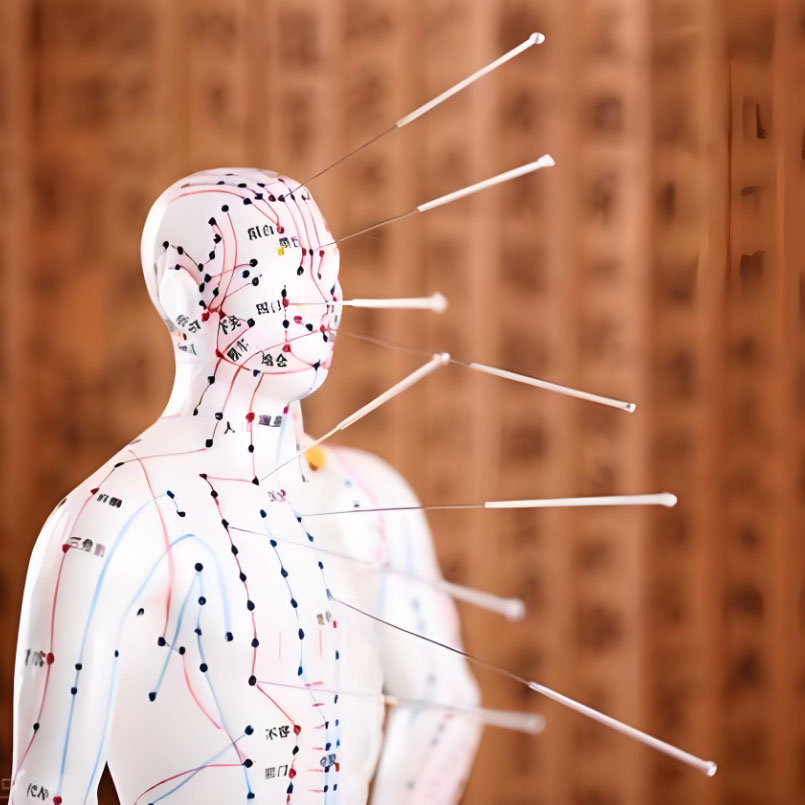
When it comes to TCM wellness, the therapeutic and health-preserving effects of meridians and acupoints are indispensable. People often encounter a common problem when selecting acupoints for health maintenance: how to accurately locate an acupoint.
First, one should consult the written description of the acupoint location in professional TCM texts. Second, some foundational knowledge of modern anatomy is helpful. By combining this with several acupoint location methods introduced in meridian theory, one can accurately find the acupoints.
The commonly used acupoint locating methods are the Anatomical Landmark Method, the Proportional Bone Cun Method, and the Finger Measurement Method.
There are certain fixed and prominent landmarks on the human body. The method of locating acupoints based on these fixed landmarks is called the Anatomical Landmark Method. For example, the acupoint on the tip of the nose is Suliao (GV25); the point between the two eyebrows is Yintang (EX-HN3); the point between the two nipples is Danzhong (CV17); and the center of the navel is Shenque (CV8).
The Proportional Bone Cun Method uses the bones and joints of the body as primary markers to measure the length and size of various body parts. Based on these measurements, proportional scaling is used as a standard for acupoint location. For example, the distance from the anterior hairline midline to the posterior hairline midline is 12 cun; between the two frontal hairline corners is 9 cun; between the two nipples is 8 cun; from the sternocostal angle (xiphoid process) to the navel is 8 cun; from the elbow crease to the wrist crease (dorsal or palmar) is 12 cun; and from the popliteal crease to the tip of the lateral malleolus is 16 cun. It is crucial to note that the "cun" used in the Proportional Bone Cun Method is not the standard unit of measurement used in daily life, but rather refers to "equal divisions." Regardless of age, gender, body type, or height, each equal division counts as one cun, and this standard serves as the basis for measuring acupoints.
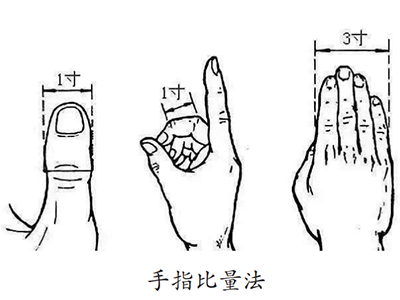
Another method is the Finger Measurement Method, which uses the individual's own fingers as the standard for proportional measurement to locate acupoints. This is also called the "Body Cun" method.
Taking Zusanli (ST36) as an example: starting from the lateral knee crease (Dubi, ST35), use the finger measurement method to measure four finger-widths (3 cun) downward to determine a horizontal line. On the front of the lower leg, the bone that can be felt directly under the skin is the tibia; one finger-width (1 cun) lateral to the tibia determines a vertical line. The intersection of this horizontal and vertical line is the location of Zusanli (ST36).
There are also some simplified locating methods. For instance, when the arms are flexed, hanging naturally down while tightly hugging the chest wall, the point directly opposite the olecranon (elbow tip) is Zhangmen (LR13). When making a fist, the point pressed by the tip of the middle finger is Laogong (PC8). Acupoints like these are relatively easier to locate accurately.
For most acupoints, combining these methods allows one to pinpoint their exact locations. If any uncertainties remain, one should seek assistance from a professional TCM practitioner.
Furthermore, some people may worry: "What if I press the wrong acupoint, or cause harm?" Generally speaking, aside from a few specific contraindications, the vast majority of acupoints are safe. Key precautions include: Do not press areas with fractures, dislocations, or broken skin. For pregnant women, acupoints on the lumbosacral region and lower abdomen should not be pressed excessively. For individuals who are frail or debilitated, acupressure should not be overly vigorous to avoid depleting qi and blood. In short, the principle of acupressure for health is to take one's own comfort and well-being as the measure. If any discomfort occurs, stop promptly.
