
Healing Library
Astragalus membranaceus (Huang Qi) — The Immune Qi Builder
Astragalus (Huang Qi) is the premier TCM herb for tonifying qi, securing the exterior, and boosting immunity and digestion. Explore its benefits, classical formulas like Yu Ping Feng San and Bu Zhong Yi Qi Tang, and modern research — plus tips for daily use in teas and soups.
The Great Qi Tonifier
If ginseng is the king of qi-tonifying herbs, then Huang Qi — Astragalus membranaceus — is the general. While ginseng is reserved for deep, systemic qi deficiency and emergency rescue of collapsed vitality, Astragalus is the everyday workhorse for strengthening the body's defensive and digestive functions. It is one of the most frequently prescribed herbs in Chinese medicine, and in recent decades it has become one of the best-known TCM herbs in the West, thanks to a growing body of research on its immune-modulating and anti-aging properties.
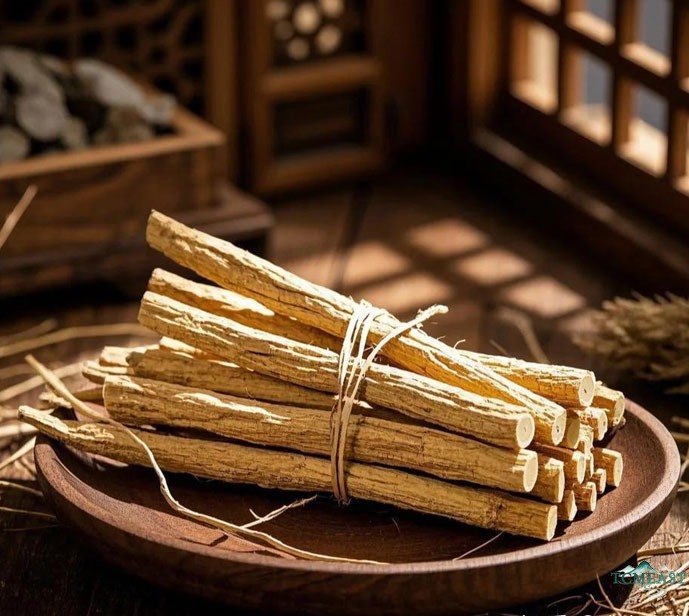
The Chinese name Huang Qi (黄芪) literally means "yellow leader" — a reference to the yellow color of the dried root and its status as a leading herb in its category. Its reputation has earned it a place in countless formulas, from the famous Yu Ping Feng San (Jade Windscreen Powder) for preventing colds to Bu Zhong Yi Qi Tang (Tonify the Middle and Augment the Qi Decoction) for digestive fatigue and organ prolapse.
What Is Astragalus?
Astragalus membranaceus (synonymous with Astragalus propinquus) is a perennial herb in the Fabaceae (legume/pea) family. The medicinal part is the dried root, harvested from plants 3-5 years old.
There are two primary species used medicinally:
- Astragalus membranaceus (Fisch.) Bge. var. mongholicus (Bge.) Hsiao — grown mainly in Inner Mongolia, considered the highest quality
- Astragalus membranaceus (Fisch.) Bge. — more widely cultivated across northern China
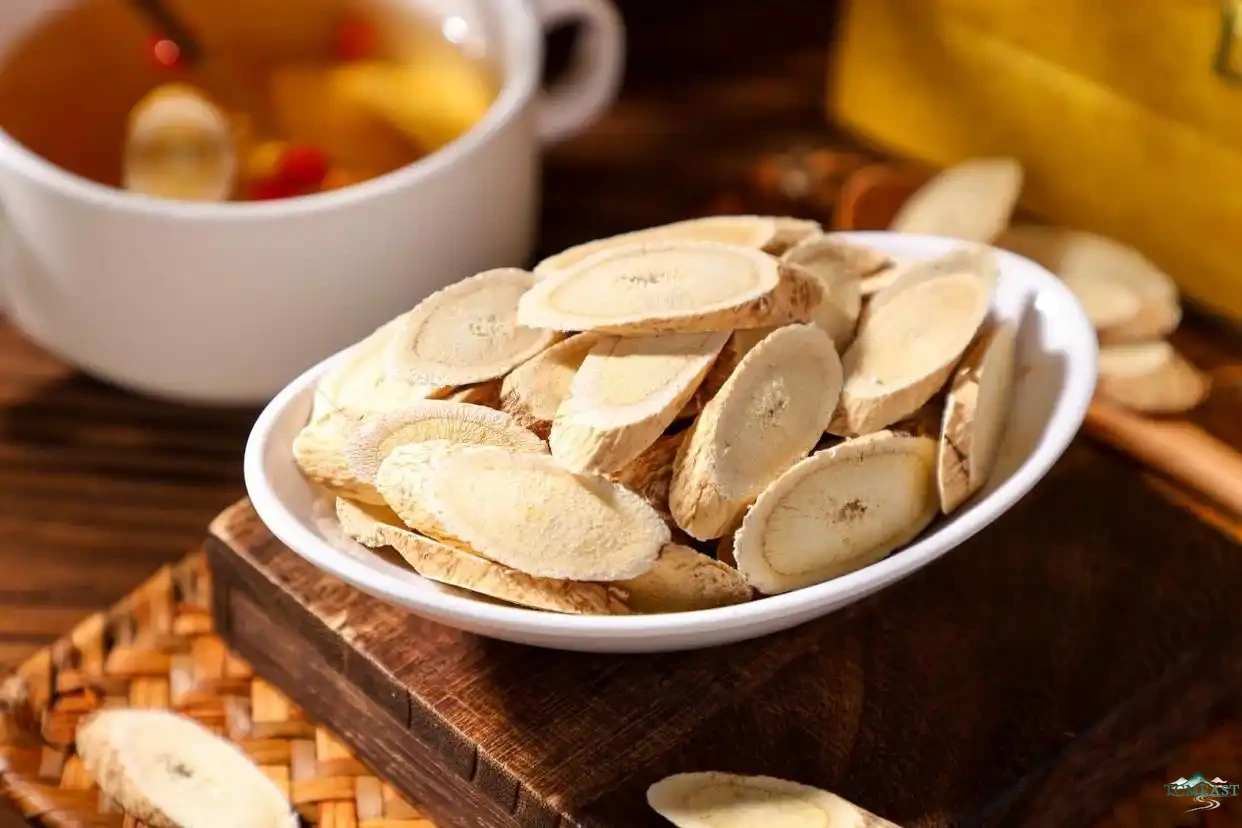
The root is harvested in spring or autumn, dried, and sliced into thick, angled pieces for use. The prepared form — honey-fried Astragalus (炙黄芪) — is also common, with a slightly different therapeutic emphasis.
Nature, Flavor, and Meridian Affiliation
- Nature: Slightly warm (微温)
- Flavor: Sweet (甘)
- Meridians: Spleen and Lung
The sweet flavor enters the Spleen and Lung systems. The warm nature gently stimulates qi and yang without the intensity of ginseng. This makes Astragalus suitable for long-term use in chronic deficiency conditions — it builds strength gradually and sustainably.
An important distinction from ginseng: Astragalus enters only the Spleen and Lung meridians, while ginseng enters four. This narrower focus makes Astragalus more targeted: it specializes in the production and circulation of wei qi (defensive qi), the body's immunological barrier, through its action on the Spleen (source of qi production) and Lung (distributor of qi to the surface).
Actions and Indications
1. Lifts Spleen Qi and Raises Sunken Qi (补气升阳)
Astragalus's most fundamental action is to strengthen Spleen qi — the digestive system's ability to transform food into energy and blood. When Spleen qi is deficient, the result is fatigue, poor appetite, loose stools, and a sensation of heaviness or sluggishness.
More specifically, Astragalus has a lifting and raising effect on qi, which is why it is the key herb in formulas for sinking of middle qi (中气下陷) — a pattern characterized by:
- A bearing-down or dragging sensation in the abdomen
- Organ prolapse (stomach, uterus, rectum)
- Chronic diarrhea or hemorrhoids
- A feeling of heaviness in the limbs
- A weak, low-energy voice
The classic formula addressing this pattern is Bu Zhong Yi Qi Tang (补中益气汤), created by the great physician Li Dongyuan in the 13th century.
2. Secures the Exterior and Stops Sweating (固表止汗)
This is Astragalus's most widely known action in the West. By strengthening the Lung's ability to circulate wei qi to the body surface, Astragalus "secures the exterior" — meaning it tightens the boundary between the body and the environment.
When wei qi is weak, the "pores" (毛孔) — the TCM concept of the skin's barrier function — remain open, allowing external pathogens to enter easily. This manifests as:
- Frequent colds and respiratory infections
- Spontaneous sweating (sweating with minimal exertion or at rest)
- Allergy symptoms (sneezing, runny nose, watery eyes)
- A general feeling of vulnerability to weather changes
The classic formula Yu Ping Feng San (玉屏风散, Jade Windscreen Powder) combines Astragalus with Bai Zhu (atractylodes) and Fang Feng (ledebouriella) to create a "wind screen" that protects the body surface.
3. Promotes Urination and Reduces Edema (利水消肿)
Astragalus has a gentle diuretic effect that works by strengthening Spleen and Lung qi — when the qi that governs water metabolism is weak, fluids accumulate as edema. This makes Astragalus useful in conditions involving fluid retention, especially when accompanied by signs of qi deficiency.
4. Supports Wound Healing and Tissue Repair (托毒排脓, 敛疮生肌)
Applied both internally and externally, Astragalus promotes the healing of chronic, non-healing wounds and ulcers. It does this by:
- Strengthening the body's qi to generate new tissue
- "Supporting" pus discharge from infected wounds (托毒排脓)
- Promoting the closure of slow-healing sores (敛疮生肌)
This action is recorded as early as the Shennong Bencao Jing, which states that Astragalus "governs carbuncles and chronic sores that have suppurated for a long time."
Classical Foundation
Shennong Bencao Jing (Divine Farmer's Materia Medica, ~1st century CE):
"Astragalus governs carbuncles and infected sores that have lasted a long time, expels pus and relieves pain. It also treats rheumatic pain, hemorrhoids, and flaccidity of the limbs."
Bencao Huiyan (Compendium of Materia Medica Discourses, 1624), by Ni Zhumo:
"Astragalus is the most important herb for supplementing the Spleen and Lungs. Its qi is light and ascending, so it is able to lift the clear yang of the middle burner. Combined with ginseng, it greatly strengthens the primordial qi."
Dr. Li Dongyuan (1180-1251), founder of the School of Spleen and Stomach, made Astragalus the cornerstone of his approach. He wrote extensively about its ability to "lift the clear yang of the middle burner" — a concept that became central to TCM clinical practice.
Modern Pharmacological Understanding
Astragalus has been the subject of extensive scientific research, particularly in China, Japan, and increasingly in Western institutions. The primary active compounds are:
- Astragalus polysaccharides (APS) — the most studied component, with significant immune-modulating properties
- Astragalosides (cycloartane-type triterpene saponins) — particularly Astragaloside IV, which has garnered attention for its anti-fibrotic and cardioprotective effects
- Flavonoids — including formononetin, calycosin, and ononin
Key research findings:
| Area | Key Compound | Observed Effects |
|---|---|---|
| Immune modulation | APS | Enhances T-cell, macrophage, and NK cell activity |
| Anti-aging | APS, Astragaloside IV | Telomerase activation, reduced oxidative stress |
| Cardioprotection | Astragaloside IV | Improved cardiac function, anti-fibrotic effect |
| Antiviral | APS | Inhibits viral replication in vitro |
| Metabolic health | APS | Improved insulin sensitivity, glucose regulation |
| Wound healing | Astragaloside IV | Accelerated tissue repair in animal models |
A notable 2023 systematic review in Frontiers in Pharmacology (PubMed: 36925684) analyzed 48 clinical trials and found that Astragalus-containing formulas significantly improved immune function markers and reduced infection frequency in immunocompromised patients. The review noted that consistent results were seen with daily doses equivalent to 20-40g of the raw herb.
Dosage and Preparation
| Form | Daily Dose | Notes |
|---|---|---|
| Raw Astragalus (生黄芪) | 9-30g | Standard dose for general qi deficiency |
| Honey-fried Astragalus (炙黄芪) | 9-30g | Warmer, more focused on Spleen qi and digestion |
| High dose | 60-120g | Used in certain conditions like severe organ prolapse |
| Tea/infusion | 5-10 slices | Steep in hot water for 10-15 minutes |
Key preparation notes:
- Astragalus decoctions benefit from a longer cooking time — 30-45 minutes in total.
- Raw Astragalus (生黄芪) is preferred when the goal is to secure the exterior, promote urination, or expel pus from sores.
- Honey-fried Astragalus (炙黄芪) is preferred when the goal is to strengthen Spleen function and raise sunken qi, as the honey enhances its warming, tonifying effect.
Key Combinations
| Combination | Formula | Effect |
|---|---|---|
| Huang Qi + Bai Zhu + Fang Feng | Yu Ping Feng San | Secures exterior, prevents colds and allergies |
| Huang Qi + Ren Shen (Ginseng) + Sheng Ma (Cimicifuga) + Chai Hu (Bupleurum) | Bu Zhong Yi Qi Tang | Lifts sunken middle qi |
| Huang Qi + Dang Gui (Angelica) | Dang Gui Bu Xue Tang | Generates blood from qi |
| Huang Qi + Fang Ji (Stephania) | Fang Ji Huang Qi Tang | Treats edema with qi deficiency |
| Huang Qi + Di Long (Earthworm) | Bu Yang Huan Wu Tang | Tonifies qi to move blood in paralysis/stroke recovery |
Precautions and Contraindications
Who should NOT take Astragalus:
- Excess patterns with stagnation: Individuals with acute infections, high fever, abdominal distension from food stagnation, or constipation should not take Astragalus, as its tonifying nature can trap pathogens
- Yin deficiency with heat signs: People with night sweats, five-palm heat, dry mouth, or irritability from yin deficiency may find Astragalus too warming
- Hypertension: Some forms of hypertension, particularly with liver yang rising (red face, headache, irritability), may worsen with Astragalus
Drug interactions:
- Immunosuppressants: Astragalus may theoretically reduce the effectiveness of immunosuppressive medications (used in organ transplantation, autoimmune conditions)
- Lithium: Astragalus may increase lithium levels by affecting renal clearance — monitor if taken concurrently
- Diuretics: Possible additive effect with Astragalus's mild diuretic action
Pregnancy and lactation:
Astragalus is generally considered safe during pregnancy in food amounts and in many TCM formulas for threatened miscarriage (with appropriate combination herbs). Therapeutic doses should be taken only under the guidance of a qualified practitioner.
How to Choose and Store Astragalus
Selecting quality Astragalus:
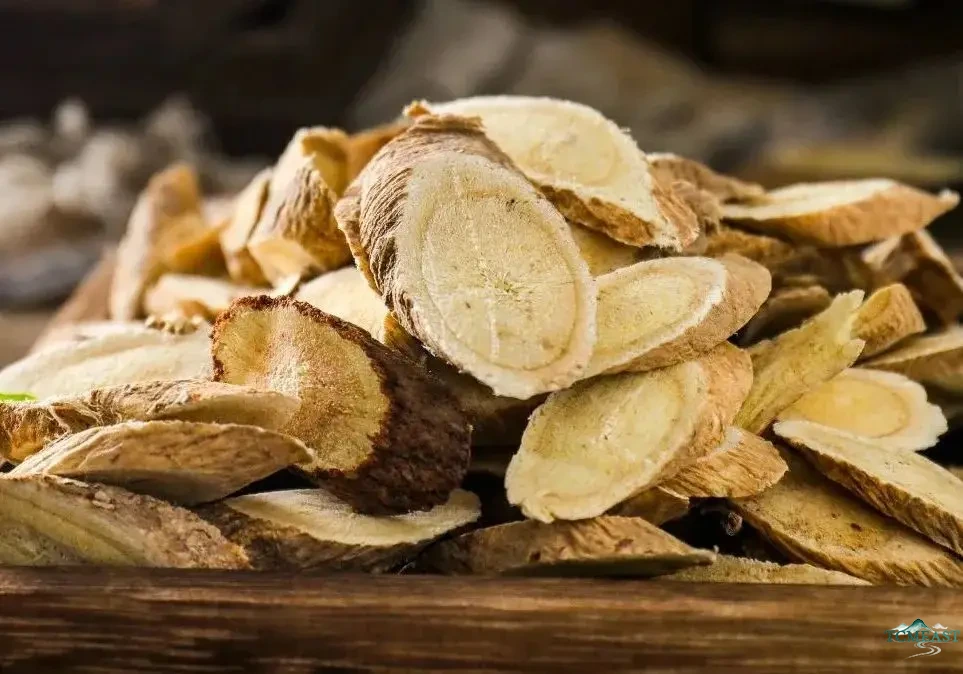
- Appearance: Look for thick, long, uniform slices with a light yellowish-brown exterior and a bright yellow inner cross-section
- Texture: The root should be firm and heavy, not soft or spongy
- Aroma: Pleasant, sweet, earthy fragrance — slightly bean-like (it is a legume)
- Taste: Sweet, slightly mucilaginous when chewed
- Sulfur detection: Overly white or uniformly pale slices with a sour smell indicate sulfur fumigation — avoid these
Differentiation from toxic look-alikes:
This is an important safety point. The herb Zhu Jie Xiang Fu (root of Crotalaria sessiliflora or C. juncea) has been sometimes confused with or substituted for Astragalus. These look-alikes contain pyrrolizidine alkaloids with known hepatotoxicity. Always purchase Astragalus from reputable sources with proper botanical identification.
Storage:
Store dried Astragalus slices in an airtight container in a cool, dry place away from direct sunlight. Properly stored, it will maintain its potency for 1-2 years. Honey-fried Astragalus is more hygroscopic and should be refrigerated in a sealed container.
Daily Use: Astragalus Tea and Beyond
Astragalus is one of the most user-friendly TCM herbs for daily use. Its mild, slightly sweet flavor makes it palatable as a tea or in cooking.
Simple Astragalus Tea:
- Place 5-10 slices (about 5-10g) in a thermos or teapot
- Pour in boiling water and steep for 10-15 minutes
- Drink throughout the day, refilling with hot water 2-3 times
You can combine Astragalus with:
- Goji berries (for a nourishing, antioxidant-rich tea)
- Red dates (jujube) for added sweetness and blood-building
- Licorice root (1-2 slices) for enhanced Spleen qi effect
Astragalus in Cooking:
- Add a handful of slices to chicken or bone broth during the last hour of simmering
- Include in vegetable soups with ginger and garlic
- Steep in congee (rice porridge) for a nourishing breakfast
- Combine with Dang Gui (angelica) in simmered soups for a classic postpartum recovery tonic
Common Questions Answered
Q: Can Astragalus prevent colds?
A: Yes, but not in the way a vaccine would. Regular use strengthens wei qi, reducing the frequency and severity of respiratory infections. It is most effective when taken consistently over weeks to months, not as an acute treatment once a cold has started.
Q: How long does it take to feel the effects of Astragalus?
A: Unlike stimulants that produce immediate effects, Astragalus works gradually. Most people report noticeable improvements in energy and resistance after 2-4 weeks of daily use.
Q: Is Astragalus safe for long-term use?
A: Yes. Astragalus is classified as a safe herb for extended use when taken at standard doses and when it matches the individual's pattern. TCM texts describe it as a "gentle tonic" that builds strength gradually without causing side effects.
Q: What is the difference between Astragalus and Echinacea?
A: Both are used for immune support, but their mechanisms differ. Echinacea is primarily an acute immune stimulant — best used at the first sign of infection, not continuously. Astragalus is a chronic immune regulator — best used over the long term to strengthen the system's baseline resilience. They can be seen as complementary rather than interchangeable.
Q: Does Astragalus increase blood pressure?
A: Research is mixed. Some studies suggest Astragalus may lower blood pressure in hypertensive individuals through its vasodilatory effects. However, in some individuals with certain types of hypertension (particularly yang-excess patterns), it may have a mild pressor effect. If you have hypertension, consult a practitioner before regular use.
