The Path of Qihuang
Legendary Physician of High Antiquity — The Yellow Emperor (Huangdi)
The Yellow Emperor (Huangdi), also known as Xuanyuan Shi and Youxiong Shi, was the legendary sovereign of the ancient Chinese nation and the first of the Five Emperors. Named for the yellow earth by whose virtue he ruled, he unified the Central Plains, invented writing, the sexagenary calendar, music, boats, and chariots, and is revered as the founding father of Chinese medicine. Together with Qibo, Lei Gong, and others, he discussed pathology and compiled the Huangdi Neijing (Yellow Emperor's Inner Canon), laying the theoretical foundation of TCM. This article details his political, technological, and medical achievements, illuminating the cultural roots of the “descendants of Yan and Huang” and the sacred origins of Chinese medicine.
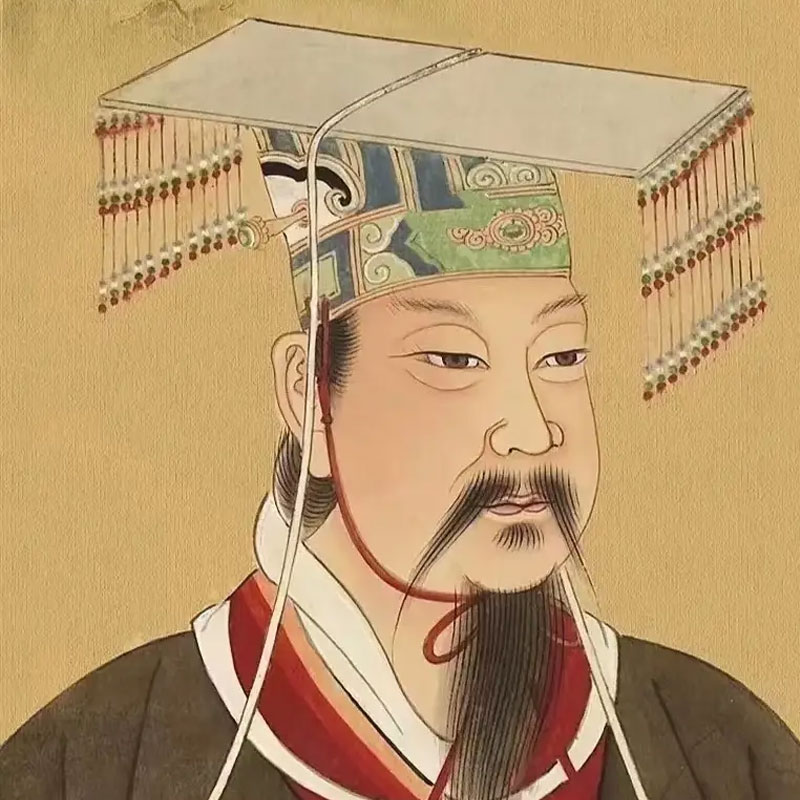
The Yellow Emperor is the legendary common sovereign of the ancient Chinese nation and the first of the Five Emperors. It is said that his surname was Gongsun, and that he was born upon the Mound of Xuanyuan, hence his title Xuanyuan Shi (Xuanyuan Clan). Having grown to adulthood by the banks of the Ji River, he also adopted Ji as his clan surname. Later, having established his state at Youxiong, he was also known as Youxiong Shi. He ruled by the virtue of earth, which is yellow in color, and was therefore called the Yellow Emperor. The Yellow Emperor is a figure of ancient historical legend, and the most stirring of all the tales about him are undoubtedly his wars against the Yan Emperor and Chi You. Tradition credits him with numerous inventions, including sericulture, boats and chariots, weapons and arrows, writing, clothing, music, arithmetic, and much more. Classical Chinese texts also contain numerous records of the Yellow Emperor's creation and invention of medicine. The Diwang Shiji (Annals of the Emperors and Kings) states: “The Yellow Emperor dispatched Qibo to taste the flavors of herbs and to standardize the treatment of disease; the classical formulas and materia medica texts all emerged from this.” The Tongjian Waiji (Supplementary Records to the Comprehensive Mirror) also records: “The Yellow Emperor observed that human beings carry yin on their backs and embrace yang in their arms, taste the five flavors and are colored by the five hues; cold and heat buffet them from without, joy and anger assail them from within — premature death, infirmity, disease, and epidemics afflict rulers and people alike across the generations. Therefore, he traced the patterns upward to the heavens and downward to the earth; he examined the five colors, established the five circuits (wu yun), penetrated the nature of life and destiny, and recorded the principles of yin and yang. Consulting with Qibo, he composed the Neijing (Inner Canon). He further commanded Yu Fu, Qibo, and Lei Gong to examine the Bright Hall points and to investigate the pulse and respiration; Wu Peng and Tong Jun to prescribe formulas and medicinals — thus enabling the people to live out their full natural lifespan.” The fact that the above medical works were titled under the name of the “Yellow Emperor” reflects the reverence and admiration which the people held for him.
The Contributions of the Yellow Emperor
According to Chinese historical records, after the era of the Yan Emperor, the Yellow Emperor unified all the tribes of China — with three proposed locations for his capital: Qufu, Xinzheng, and Zhuolu. He devised the calendar; taught the people to sow the five grains; promoted writing; created the sexagenary stem-branch system; established music; and founded medicine.
Timekeeping: The Emperor commissioned Da Rao to create the sexagenary cycle (jiazi), using the ten heavenly stems matched with the twelve earthly branches to record time. This system, in which cycles from Jiazi, Yichou, and so forth through Guihai comprise a sixty-year cycle — the sixty yuan-chen of Daoism — has been used down to the present day in the lunar calendar.
Mathematics: Li Shou created numbers and established the system of weights and measures.
Military: Feng Hou derived the Woqi Diagram and first created systematic battle formations.
Music: Ling Lun took bamboo from the valleys to craft the xiao pipes, establishing the five tones and twelve pitches, which remain congruent with those of today.
Clothing: The primary consort Lei Zu first raised silkworms and used the silk to fashion garments.
Medicine: The Yellow Emperor discussed pathology with Qibo and composed the Neijing (Inner Canon).
Writing: Cangjie first created written characters, establishing the methodology of the Six Scripts.
Metallurgy: Copper was mined from Mount Shou, five li south of Xiangcheng County in Henan, to cast currency.
Other: The invention of boats and chariots, bows and arrows, housing, and more.