Wisdom of TCM
The Theory of the Five Elements (Wu Xing)
The Five Elements (Wu Xing) theory is an ancient Chinese philosophical framework studying the properties, characteristics, and generating-restraining laws of wood, fire, earth, metal, and water, embodying rudimentary system theory. This article explains how it permeates TCM, serving as a methodology for interpreting the relationship between humans and nature, the integrity of the human body, and inter-organ connections, and is broadly applied in clinical diagnosis, pathological analysis, herbal treatment, and acupoint combination—forming a cornerstone of TCM theory.
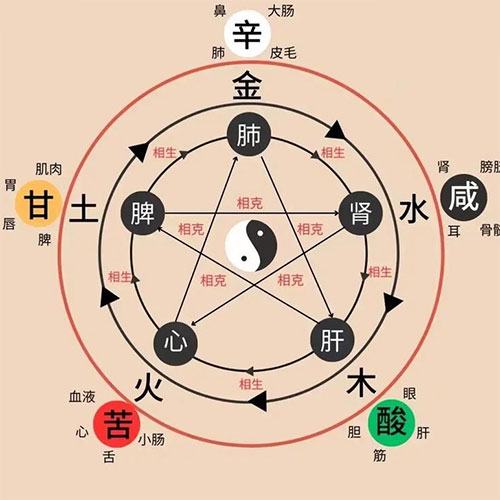
The Five Elements theory is an ancient philosophy that studies the connotation, characteristics, and the laws of generating, restraining, engendering, and controlling (sheng-ke-zhi-hua) of the five elements. It categorizes various phenomena in nature and the tissues, organs, and manifestations of the human body based on the properties of the five elements, and uses the laws of generating and restraining to explain the interrelationships among all things in the universe. It represents the materialist-dialectical worldview and methodology of ancient China and also embodies rudimentary systems thinking. The theory holds that all phenomena in the universe can be classified, at different levels, into the five categories of wood, fire, earth, metal, and water, thereby forming systemic structures of varying orders. The generating and restraining relationships among the five elements maintain relative stability within and between these systems. Thus, the Five Elements theory is essentially the study of the most general functional and structural relationships within and between things.
The theoretical system of Traditional Chinese Medicine took shape during the Warring States period through to the Qin and Han dynasties, a time when the prevailing Five Elements theory was inevitably incorporated into Chinese medicine. TCM has extensively applied the Five Elements theory at various levels, including explaining the relationship between humans and nature, the holistic integrity and systemic nature of the human body itself, the interconnections among the body's various systems, as well as in clinical diagnosis, pathological analysis, therapeutic medication, pharmacological analysis, and the combination of acupuncture points. While applying the Five Elements theory, TCM has also enriched and further developed it, enabling the theory to more effectively explain complex issues in the medical field, and has integrated it with medical theory and clinical practice, making it a constituent part of the TCM theoretical system.