
Congees
Buzhong Yiqi Porridge
Buzhong Yiqi Porridge (Qi-Supplementing Porridge) is a classic medicinal porridge originating from Li Dongyuan's Treatise on the Spleen and Stomach from the Jin-Yuan Dynasty. It features astragalus – known as the "supreme qi tonic" – and codonopsis, which strengthens the spleen and supplements qi, simmered with japonica rice (or millet). The porridge is thick and smooth, with a light herbal aroma and a subtly sweet taste. It is renowned for supplementing middle qi, strengthening the spleen and stomach, and lifting yang to treat prolapse. It is particularly effective as dietary therapy for fatigue, loss of appetite, and weakness caused by middle qi deficiency and spleen-stomach weakness. Total cooking time is about 1 hour (including decoction time) – an ideal daily tonic for nourishing qi and blood.
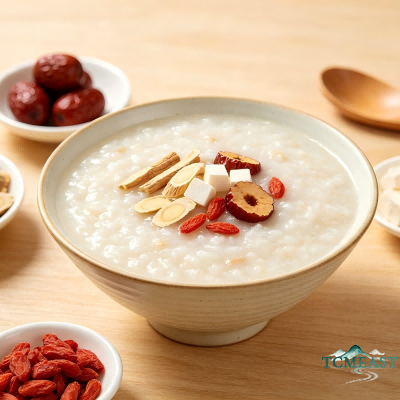
Main Ingredients
- Astragalus root (Huangqi) 30g
- Codonopsis root (Dangshen) 15g
- Japonica rice (or millet) 100g
- Brown sugar or white sugar to taste
- Water 1500ml
- Atractylodes (Baizhu) 15g
- Cimicifuga (Shengma) 10g
- Chinese angelica (Danggui) 10g
- Bupleurum (Chaihu) 5g
- Tangerine peel (Chenpi) 5g
Steps
Rinse the astragalus, codonopsis (and the additional herbs if using the advanced version) quickly under running water to remove dust. Place the herbs in a clay pot or stainless steel pot (avoid iron pots). Add approximately 600ml of water and soak for 30-40 minutes.
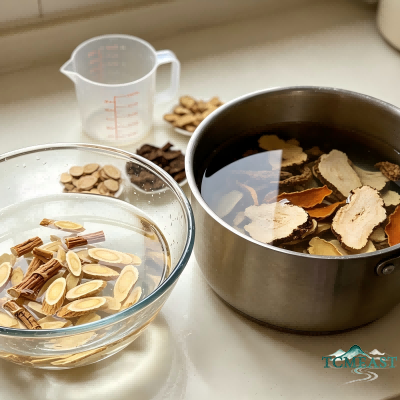
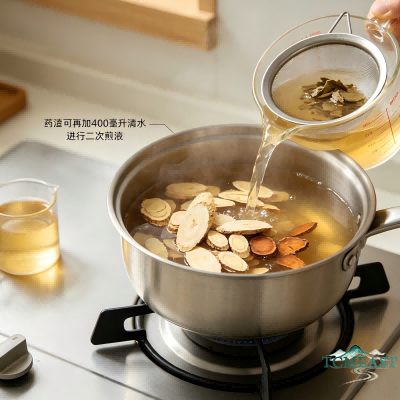
Place the pot with the soaked herbs on the stove. Bring to a boil over high heat, then reduce to low heat and simmer for about 30 minutes until the liquid reduces to approximately 100-150ml. Strain through a fine mesh sieve, reserving the liquid. For maximum extraction, add another 400ml of water to the herbal residue and simmer for 20 minutes. Strain and combine with the first extraction (total approximately 200-250ml).
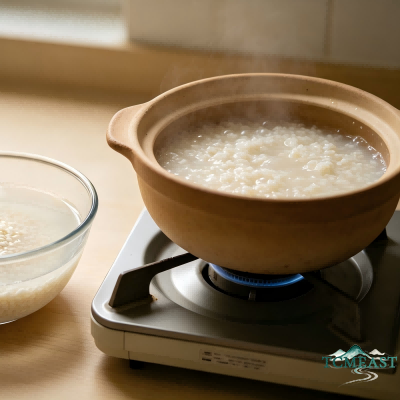
Rinse the japonica rice (or millet) and place in a clay pot with approximately 900ml of water. Bring to a boil over high heat, then reduce to low heat and simmer for about 30-40 minutes until the rice grains bloom and the porridge thickens.
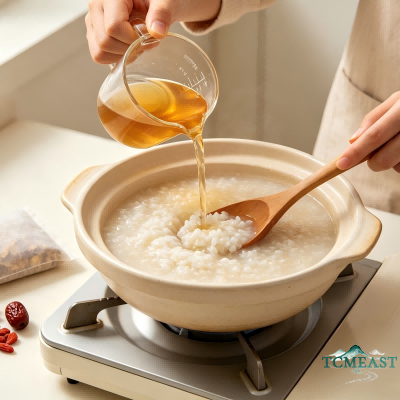
When the porridge is nearly done, slowly pour the herbal liquid into the porridge, stirring continuously to fully incorporate. Continue simmering over low heat for 5-8 minutes to allow the medicinal properties to fully integrate with the porridge. Alternative method: Wrap the herbs in a cheesecloth bag and cook directly with the rice; remove the bag after the porridge is done.
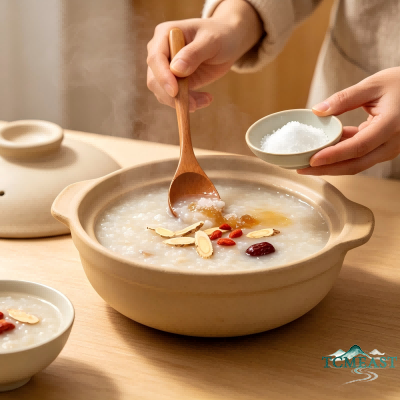
Add brown sugar or white sugar to taste, stirring until fully dissolved. Turn off the heat and let it rest, covered, for 5 minutes to thicken further. Consume warm on an empty stomach, 1-2 times daily. A course of 3-5 days is recommended, with a 2-3 day break between courses.
TCM Notes
Astragalus root (Huangqi) : Sweet in taste and slightly warm in nature, acts on the Spleen and Lung meridians. Rich in astragalus polysaccharides, astragalosides, and amino acids. Polysaccharides significantly modulate immune function by enhancing macrophage activity; saponins help dilate blood vessels and improve microcirculation. In TCM, it is known to supplement qi and elevate yang, strengthen the exterior, and promote diuresis – revered as the "supreme qi tonic." Codonopsis root (Dangshen) : Sweet in taste and neutral in nature, acts on the Spleen and Lung meridians. It supplements middle qi and strengthens the spleen and lungs. Codonopsis improves gastrointestinal motility and is effective for poor appetite and indigestion caused by spleen-stomach weakness. Japonica rice / Millet: Japonica rice nourishes the spleen, stomach, qi, and blood – when cooked into porridge, it not only builds qi and strength but also harmonizes the stomach; millet strengthens the spleen, harmonizes the stomach, promotes digestion, and provides energy. Brown sugar: Promotes blood circulation and warms the middle to nourish blood. The porridge collectively achieves the effects of supplementing middle qi, strengthening the spleen and stomach, and lifting yang to treat prolapse. One serving (approx. 300ml) provides about 150-200 kcal (depending on sugar content), low in fat and sodium, rich in dietary fiber and plant-based protein. Note: The basic version (Astragalus + Codonopsis) is suitable for daily qi-deficiency regulation. The advanced seven-ingredient version has stronger medicinal properties and is recommended for use under the guidance of a TCM practitioner.
Suitable for:Those with middle qi deficiency – fatigue, weakness, shortness of breath, and lack of energy Those with spleen-stomach weakness – poor appetite and indigestion Those recovering from chronic illness, post-surgery, or internal fatigue and strain Those with spontaneous sweating, palpitations, or shortness of breath Those with chronic diarrhea or prolonged dysentery from spleen deficiency Those with qi and blood deficiency – pale complexion and low immunity Those with gastroptosis, rectal prolapse, or uterine prolapse (requires the advanced seven-ingredient version)
Not suitable for:Those with exterior pathogenic conditions (colds with fever, chills without sweat, headache, body aches) : Should focus on dispersing pathogens, not tonifying qi, to avoid trapping pathogens inside Those with Excess-Heat conditions: High fever, red face, dry throat, dark urine, constipation – astragalus may aggravate heat Those with internal Damp-Heat or yellow-greasy tongue coating: This warming tonic may worsen damp-heat Those with Yin-deficiency with Fire-Excess: Hot palms/feet, night sweats, dry mouth – warming tonics may further deplete body fluids Those with food stagnation or abdominal distension: Those with weak digestion should resolve stagnation before taking tonics Diabetic patients: Strictly control sugar intake or use alternative sweeteners Pregnant and breastfeeding women: Consult a doctor before consumption Those allergic to astragalus, codonopsis, or any of the ingredients Avoid consuming with radish or tea during the course (radish disperses qi; tea may reduce the herbs' effectiveness)
