
Herbal Teas
Snow Fungus and Taizishen Tea
Snow Fungus and Taizishen Tea is a nourishing herbal tea featuring snow fungus and Radix Pseudostellariae as its core ingredients. Snow fungus is known as the "poor man's bird's nest" – rich in natural colloids with a soft, smooth, and silky texture. Radix Pseudostellariae, also known as "child ginseng", is the root of Pseudostellaria heterophylla and is a rare, gentle tonic among qi-supplementing herbs. When simmered together, the moistening quality of snow fungus and the subtle sweetness of Taizishen blend into a clear,晶莹剔透, and pleasantly sweet tea. This tea is renowned for supplementing qi, nourishing yin, calming the mind, and moistening the lungs. It is especially suitable for those with qi-yin deficiency, post-illness recovery, or insomnia as a daily wellness beverage. Total cooking time is about 1-1.5 hours – simple and suitable for all seasons.
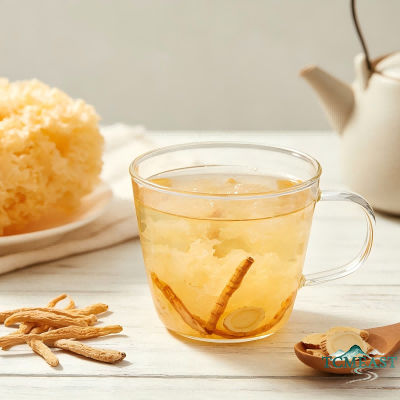
Main Ingredients
- Dried snow fungus (Tremella) 15g
- Radix Pseudostellariae (Taizishen / child ginseng) 25g
- Rock sugar to taste
- Water 1000ml
Steps
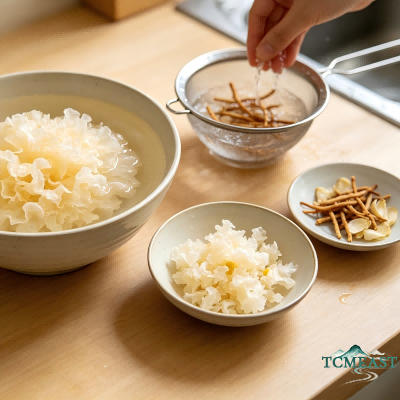
Snow fungus: Place dried snow fungus in a large bowl with plenty of cold water (warm water is also acceptable). Soak for 1-2 hours until fully expanded to 3-4 times its original size. Remove the hard yellow stem and tear the snow fungus into fingernail-sized pieces (the smaller the pieces, the greater the surface area for gelatin release). Rinse once more and drain. Taizishen: Rinse quickly under running water to remove dust. If cooking with lily bulbs, soak for 30 minutes in advance.
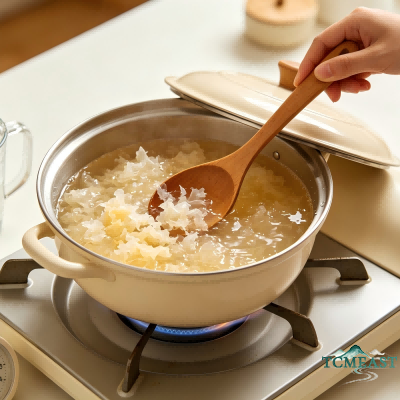
Place the shredded snow fungus into a clay pot or stainless steel pot (avoid iron pots). Add approximately 1000ml of water. Bring to a boil over high heat, then reduce to low heat (maintain a gentle simmer) , cover, and cook for about 30-40 minutes. During this time, stir vigorously in one direction for 15-20 seconds every 10 minutes (stirring increases friction and collision between snow fungus pieces, accelerating gelatin release).
When the tea has visibly thickened and gelatin begins to emerge, add the rinsed Taizishen. Continue simmering over low heat for about 20-30 minutes until the snow fungus is fully tender and the active components of Taizishen are thoroughly extracted.
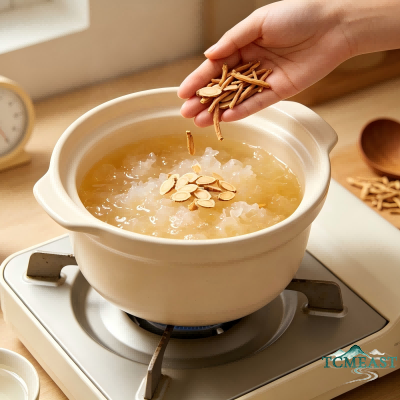
The medicinal properties of Taizishen have been fully released – you may remove and discard the Taizishen pieces with chopsticks. If texture is not a concern, they can be left in.
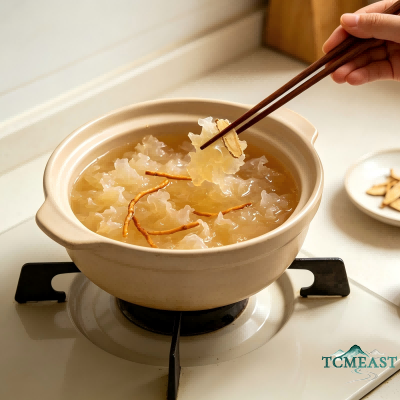
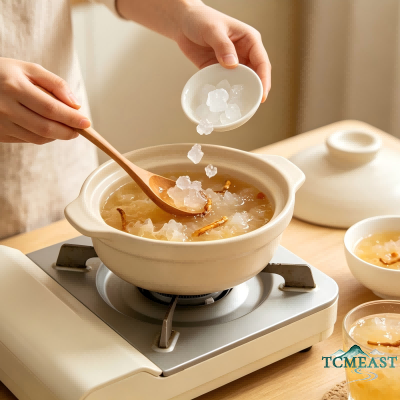
Add rock sugar and stir gently until fully dissolved, then turn off the heat. Let it rest, covered, for 5-10 minutes to allow the tea to thicken further. Serve warm or chilled. Best consumed within 24 hours.
TCM Notes
Snow fungus (Tremella) : Neutral in nature and sweet in taste, acts on the Lung, Stomach, and Kidney meridians. Rich in tremella polysaccharides, plant-based colloids, and 17 amino acids. It moistens the intestines, benefits the stomach, supplements qi, nourishes blood, and moistens the lungs to nourish yin. It is commonly used for deficiency-related coughs, blood-tinged phlegm, thirst, post-illness weakness, and shortness of breath. It is an excellent tonic for those with yin deficiency and fire excess who cannot tolerate warm tonics like ginseng or deer antler. The natural colloids in snow fungus also help moisturize the skin and slow aging. Radix Pseudostellariae (Taizishen) : Sweet and slightly bitter in taste, neutral in nature, acts on the Spleen and Lung meridians. It supplements qi and promotes fluid production, and is commonly used for post-illness weakness, fatigue, spontaneous sweating, poor appetite, dry mouth, and lung dryness with scanty phlegm. Taizishen has similar qi-supplementing and fluid-promoting effects as ginseng, but with a milder action, making it a gentle tonic that does not cause dryness – suitable for long-term use. Together, they achieve the effects of supplementing qi, nourishing yin, moistening the lungs, strengthening the spleen, and calming the mind. One serving (approx. 300ml) provides about 50-80 kcal (depending on sugar content), low in fat and sugar, rich in soluble dietary fiber and plant polysaccharides.
Suitable for:Those with qi-yin deficiency: Symptoms include fatigue, dizziness, shortness of breath, spontaneous sweating, and worsening of symptoms with activity Those recovering from illness or in post-surgery convalescence Those with palpitations, insomnia, restlessness, or neurasthenia Those with lung dryness, dry cough, or dry throat Those with spleen deficiency, poor appetite, fatigue, or spontaneous sweating Those with low immunity or prone to colds Those with yin deficiency and fire excess who cannot tolerate warm tonics like ginseng General population as a daily wellness tea, especially suitable for dry autumn and winter seasons
Not suitable for:Those with wind-cold cough: Symptoms include chills, clear nasal discharge, and thin white phlegm – strictly avoid Those with damp-heat phlegm cough: Symptoms include thick yellow phlegm and yellow greasy tongue coating – strictly avoid Those with greasy tongue coating or heavy dampness: Symptoms include sticky mouth and sticky stools – not suitable Those with excess pathogenic factors: Should avoid or use with caution Those with hypertension: Should not consume in large amounts Those with nephritis or gastritis: Should not consume in large amounts Pregnant women: Should use with caution or avoid Taizishen During colds or coughs: Should not consume During abdominal bloating: Should not consume Those with spleen cold and chronic diarrhea: Should avoid Taizishen Avoid consuming with qi-dispersing foods such as hawthorn, raw radish, bergamot, betel nut, and garlic during use Taizishen should not be consumed with Veratrum nigrum, white radish, mung beans, grapes, or kelp
