
Soups
Stewed Pear with Fritillaria
Stewed Pear with Fritillaria is a time-honored classic medicinal dish, featuring snow pear and fritillaria as core ingredients, steamed together. The finished dish features soft pear flesh and a lightly sweet, slightly bitter broth, offering the benefits of moistening the lungs, relieving coughs, clearing heat, and transforming phlegm. Snow pear moistens dryness and generates fluids, fritillaria clears heat and transforms phlegm, and rock sugar harmonizes the formula. This recipe originates from Fruit Medicinal Use and Food Making and is a dietary therapy recommended for bronchitis patients. There are two main types of fritillaria: Chuanbeimu (Fritillaria cirrhosa) and Zhebeimu (Fritillaria thunbergii). Chuanbeimu has stronger effects and is suitable for severe coughs, while Zhebeimu is suitable for mild coughs. Chuanbeimu is more focused on moistening the lungs and relieving coughs, while Zhebeimu emphasizes clearing heat, transforming phlegm, and dispersing nodules. Chuanbeimu is more commonly used in daily dietary therapy.
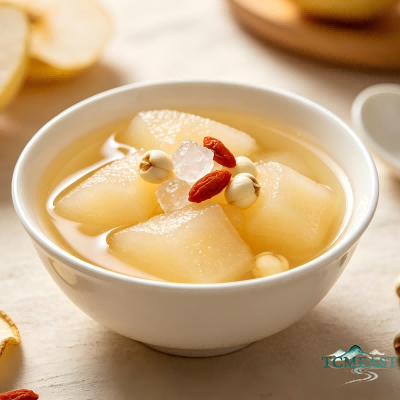
Main Ingredients
- Snow pear (or Ya pear) 1 piece
- Fritillaria powder (Chuanbeimu) 6g
- Rock sugar 15g
- Water as needed
- Goji berries a few
Steps
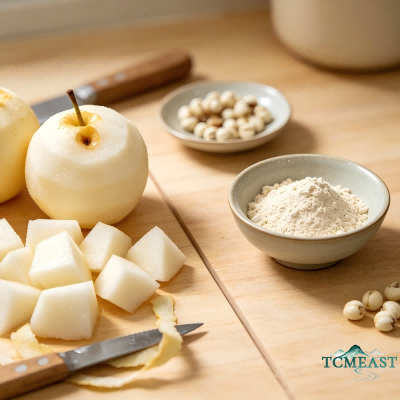
Wash, peel, and core the pear, and cut into small pieces. Grind the Chuanbeimu into powder.
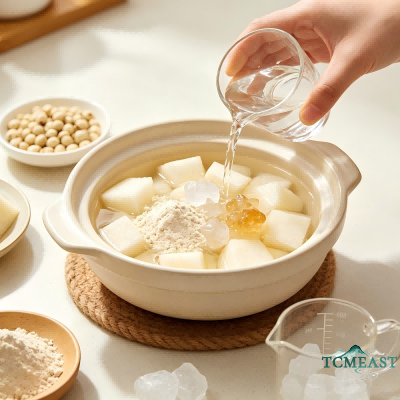
Place the pear pieces, Chuanbeimu powder, and rock sugar into a stewing pot. Add water (just enough to cover the ingredients).
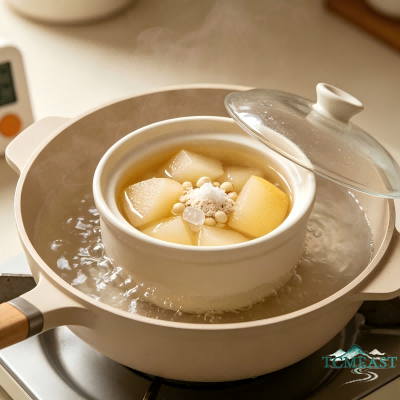
Stew for 30 minutes to 1 hour until the pear is soft. Serve warm.
TCM Notes
Chuanbeimu: Slightly cold in nature, acts on the Lung meridian. Contains various alkaloids that clear heat, transform phlegm, moisten the lungs, relieve coughs, and disperse nodules. Its alkaloids can suppress the cough center and alleviate lung-heat dry coughs. Snow pear: Cool in nature, rich in water, pectin, vitamins, and minerals. Known to moisten dryness, generate fluids, clear heat, and transform phlegm. Pectin forms a protective film on the throat mucosa, reducing irritation. Rock sugar: Generates fluids and moistens dryness, harmonizes the formula and enhances lung-moistening effects. Together, they achieve the synergistic effects of nourishing yin, moistening the lungs, relieving coughs, transforming phlegm, and soothing the throat.
Suitable for:Those with lung-heat cough: Symptoms include daytime coughing, scanty yellow sticky phlegm, or prolonged dry cough without phlegm Those with lung-dryness cough, dry cough with little phlegm, or dry itchy throat Those with acute/chronic bronchitis or senile cough Those who overuse their voice (teachers, singers, broadcasters, etc.)
Not suitable for:Those with wind-cold cough: Symptoms include cough with thin white phlegm, clear nasal discharge, and chills – strictly avoid Those with cold-phlegm or damp-phlegm: Copious thin white phlegm with foam, greasy tongue coating – strictly avoid Those with Spleen-Stomach deficiency cold: Abdominal pain, cold sensitivity, loose stools – not suitable Those with internal dampness-phlegm – not suitable Diabetic patients: Strictly control rock sugar intake Pregnant women: Use with caution Those with persistent diarrhea – not suitable Those with external fever – not suitable Contraindicated with Aconitum: Should not be used with Aconitum herbs Children: Use with caution under medical guidance
