
Congees
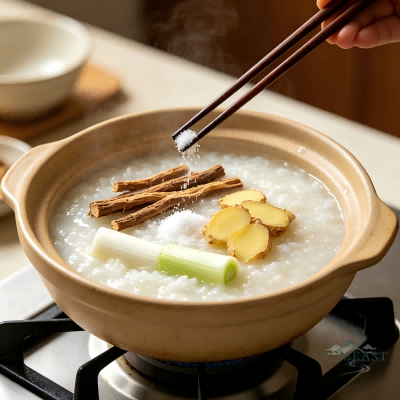
Fangfeng (Saposhnikovia) & Scallion Congee
Fangfeng & Scallion Congee is a classic herbal porridge originating from the Tang Dynasty medical classic Qianjin Yueling (千金月令). As recorded in the text: "In the first month, use Fangfeng to dispel wind from the limbs: take two portions of Fangfeng, decoct to obtain the juice, and make porridge." It combines Fangfeng (Saposhnikovia) to expel wind and release the exterior, scallion whites to induce sweating and disperse cold, and japonica rice to warm the middle and boost qi. Together, they induce sweating, release the exterior, dispel wind, and alleviate cold-related pain. The congee is smooth and warming, with a mild scallion aroma and a subtle herbal note from Fangfeng. It is traditionally used for early-stage wind-cold exterior syndrome and serves as a seasonal wellness porridge for spring wind prevention and winter cold relief.
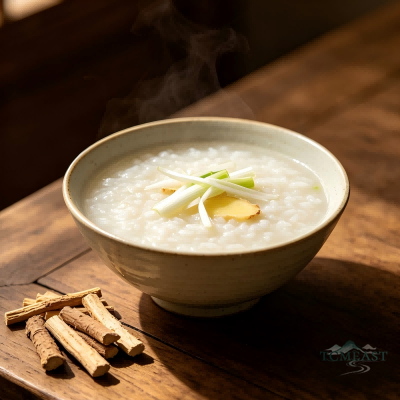
Main Ingredients
- Japonica rice (or regular rice) 100g
- Fangfeng (Saposhnikovia divaricata, a Chinese herbal medicine) 10-15g
- Scallion whites 2 stalks
- Fresh ginger 3 slices
- Salt to taste
Steps
Place rinsed rice in a clay pot with adequate water
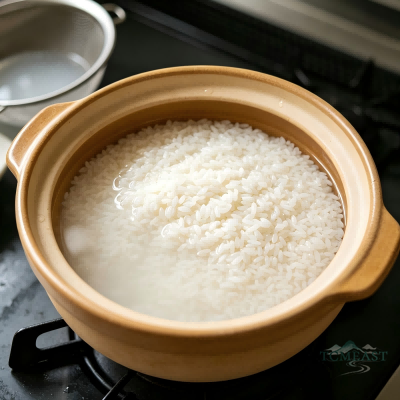
Bring to a boil over high heat, then reduce to low heat once the rice blooms.
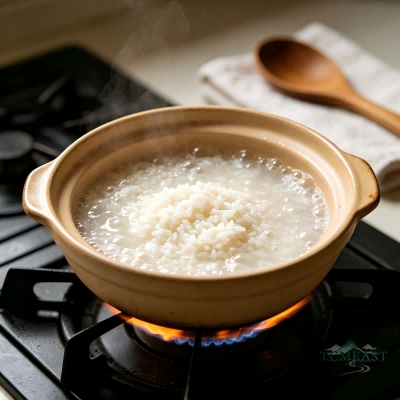
When the congee is about 80% cooked, add Fangfeng, scallion whites, and ginger (optional).
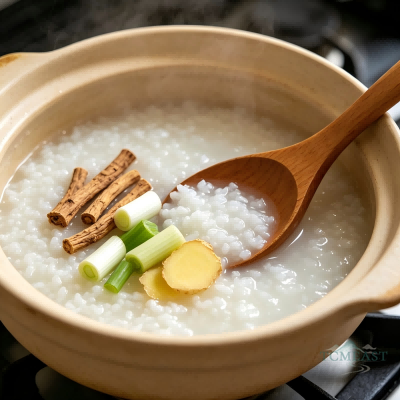
Remove Fangfeng and ginger (scallion may be eaten or discarded), season with a pinch of salt.
TCM Notes
Fangfeng (Saposhnikovia): Pungent, sweet, and slightly warm in nature; enters the Bladder, Liver, and Spleen meridians. It expels wind, releases the exterior, alleviates dampness-related pain, and stops spasms. Known in traditional medicine as the "moistening agent among wind-dispelling herbs" – it is gentle and non-drying. The Bencao Jingshu states: "Fangfeng is universally used for wind conditions; it generates and disperses, thus it is primarily used for severe wind-induced headache and dizziness, aversion to wind, and general joint pain." Modern pharmacology shows Fangfeng decoction can raise the pain threshold and has analgesic effects. Scallion Whites: Induce sweating, release the exterior, disperse cold, and unblock yang. They are primarily used for mild wind-cold common colds. When combined with Fangfeng, they enhance the exterior-releasing effect – hence the ancient text states: "Fangfeng with scallion can circulate throughout the entire body." Japonica Rice: Warms the middle, boosts qi, and enhances the medicinal effects, helping Fangfeng and scallion to induce sweating and release the exterior. Synergistic Effect: Fangfeng with scallion ensures the medicinal effect reaches the entire body; rice protects the stomach qi while enhancing efficacy, ensuring dispersion without harming the body's integrity. Total approx. 350-380 kcal, primarily carbohydrates – a low-fat warming herbal congee.
Suitable for:Those with wind-cold exterior syndrome (fever, chills, aversion to wind, spontaneous sweating, headache, body aches) Those with significant wind-cold-dampness pathogens (fever with chills, headache, nasal congestion, general soreness) Elderly with wind-cold type joint pain, headache, or dizziness Mild wind-cold common cold or mild upper respiratory infections Those with allergic rhinitis of the wind-cold type
Not suitable for:Those with yin deficiency with internal heat or excessive heat syndromes – this formula is warm and pungent in nature Those with wind-heat exterior syndrome (high fever, sore throat, yellow phlegm, etc.) Those with blood yin deficiency or heat-induced wind agitation Those with blood deficiency spasms or headache not caused by wind pathogens Those with wind-dampness-heat arthralgia syndrome Those allergic to Fangfeng – a small number of individuals may experience upper abdominal discomfort, nausea, skin itching, or redness Pregnant women – use with caution Those with weak constitution and excessive sweating – use with caution Those with liver-yang hyperactivity causing dizziness/headache – use with caution Diabetes patients – congee has a high glycemic index; consume in small portions and reduce staple food intake accordingly
