
Herbal Teas
White Radish, Ginger & Honey Water
White Radish, Ginger & Honey Water is a classic folk remedy for dispelling cold and relieving cough. White radish descends qi, aids digestion, resolves phlegm, and moistens the lungs. Ginger disperses wind-cold, warms the middle, stops vomiting, resolves phlegm, and relieves cough. Honey tonifies the middle, moistens dryness, and relieves cough. Together, the warmth of ginger balances the coolness of white radish. The drink achieves the effects of dispelling cold, relieving cough, resolving phlegm, descending qi, moistening the lungs, generating fluids, warming the middle, and aiding digestion. It is sweet with a subtle pungency, carrying the fresh aroma of white radish, the warming note of ginger, and the smooth sweetness of honey. It is especially suitable for wind-cold cough after catching a chill in autumn and winter, with white thin phlegm, itchy throat, and nasal congestion.
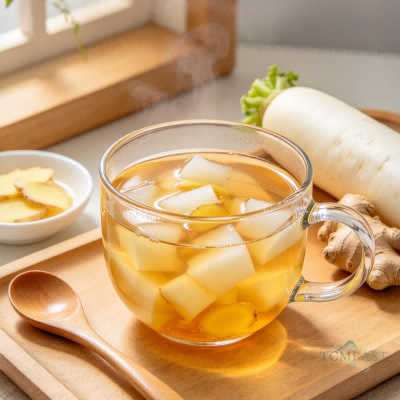
Main Ingredients
- White radish (daikon) 200-300g
- Fresh ginger 10-15g
- Honey 30-50g
- Warm water as needed
Steps
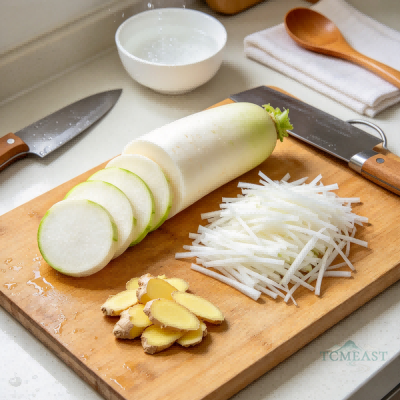
Infants under 1 year old – absolutely no honey – honey may contain Clostridium botulinum spores; infants under 1 year have an immature gut microbiome and may develop infant botulism. This is the most important safety contraindication. Those with wind-heat cough – avoid. Symptoms include high fever, sore throat, yellow thick phlegm, thirst, and yellow nasal discharge. This formula is warming and may worsen wind-heat conditions. Those with yin deficiency with internal heat – use with caution. Symptoms include hot palms/soles, dry mouth, night sweats, and insomnia. Ginger is warm and may promote internal heat. Diabetes patients – use with caution or avoid. Honey is high in sugar and raises blood glucose quickly; strictly control intake or consult a doctor for sugar substitutes. Those with gastric ulcers or hyperacidity – use with caution. Both ginger and white radish may stimulate gastric acid secretion. Those taking qi-tonifying herbs such as ginseng or astragalus – avoid concurrent use. Traditionally, white radish “descends qi” and may weaken the effects of qi-tonifying herbs. Those allergic to white radish, ginger, or honey – avoid. Pregnant women – use with caution. Ginger is warm; avoid large amounts and consult a doctor. Those taking anticoagulant medications – use with caution. Ginger may affect coagulation; consult a doctor. Wash 10-15g of fresh ginger, peel or retain the skin, and slice thinly or crush. For dispelling cold and relieving cough, peeling is recommended to enhance the warming nature; for general wellness, retain the skin.
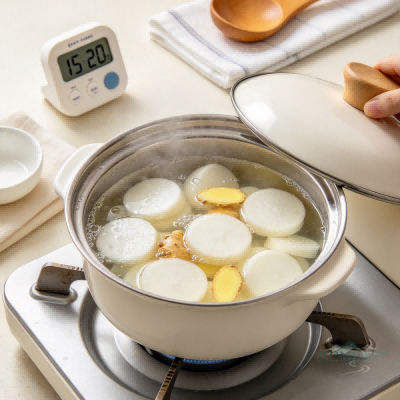
Place radish slices and ginger slices in a pot with about 500-600ml of water. Bring to a boil, then simmer over low heat for 15-20 minutes until the radish is soft and the liquid is slightly white. Turn off the heat and cool to 40-50°C (comfortable to drink). Note: Honey should not be exposed to high heat, which destroys its active enzymes and nutrients.
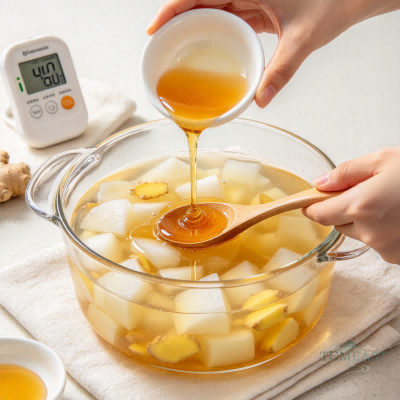
Add 30-50g of honey and stir until fully dissolved. Drink the liquid and eat the radish. 2-3 times daily, warm. Take for 2-3 consecutive days as one course.
TCM Notes
White Radish (Daikon): Contains approximately 16-20 kcal per 100g, with over 94% water content. Rich in vitamin C, dietary fiber, glucosinolates, amylase, and minerals including potassium and calcium. Known for descending qi, aiding digestion, resolving phlegm, moistening the lungs, detoxifying, generating fluids, promoting diuresis, and relieving constipation. Ginger: Pungent in taste, warm in nature; enters the Lung, Spleen, and Stomach meridians. Known for dispersing wind-cold, warming the middle, stopping vomiting, resolving phlegm, and relieving cough. Gingerol and volatile oils in ginger promote blood circulation and induce sweating, helping relieve early-stage wind-cold cold symptoms. Shogaol and other compounds help resolve phlegm, relieve cough, and warm the stomach. Honey: Sweet in taste, neutral in nature; enters the Lung, Spleen, and Large Intestine meridians. Known for tonifying the middle, moistening dryness, relieving pain, and detoxifying. Its viscous texture forms a protective layer on the throat mucosa, relieving dry cough irritation. Synergistic Effect: White radish descends qi, resolves phlegm, clears heat, and generates fluids; ginger disperses wind-cold, warms the middle, and resolves phlegm; honey moistens the lungs, relieves cough, tonifies the middle, and moistens dryness. The warmth of ginger balances the coolness of white radish, making the formula warming but not drying—suitable for wind-cold cough and those with spleen-stomach cold deficiency. Total approx. 120-180 kcal (depending on honey amount)—a low-fat, cold-dispelling, lung-moistening dietary drink.
Suitable for:Those with early-stage wind-cold colds: chills, nasal congestion, clear runny nose, itchy throat, cough with white thin phlegm Those with cough after catching a chill, worsened by cold, with white frothy phlegm Those with spleen-stomach cold deficiency, indigestion, and food stagnation Those with dry itchy throat and mild cough in autumn and winter Those with dry throat after smoking or drinking alcohol General population for autumn-winter warming, moistening, and daily wellness
Not suitable for:Infants under 1 year old – absolutely no honey – honey may contain Clostridium botulinum spores; infants under 1 year have an immature gut microbiome and may develop infant botulism. This is the most important safety contraindication. Those with wind-heat cough – avoid. Symptoms include high fever, sore throat, yellow thick phlegm, thirst, and yellow nasal discharge. This formula is warming and may worsen wind-heat conditions. Those with yin deficiency with internal heat – use with caution. Symptoms include hot palms/soles, dry mouth, night sweats, and insomnia. Ginger is warm and may promote internal heat. Diabetes patients – use with caution or avoid. Honey is high in sugar and raises blood glucose quickly; strictly control intake or consult a doctor for sugar substitutes. Those with gastric ulcers or hyperacidity – use with caution. Both ginger and white radish may stimulate gastric acid secretion. Those taking qi-tonifying herbs such as ginseng or astragalus – avoid concurrent use. Traditionally, white radish “descends qi” and may weaken the effects of qi-tonifying herbs. Those allergic to white radish, ginger, or honey – avoid. Pregnant women – use with caution. Ginger is warm; avoid large amounts and consult a doctor. Those taking anticoagulant medications – use with caution. Ginger may affect coagulation; consult a doctor.