
The Path of Qihuang
Legendary Physician of High Antiquity — Shennong (the Divine Farmer)
Shennong (the Divine Farmer), also known as the Yan Emperor, is the legendary progenitor of Chinese agriculture and medicine. Following Fuxi, he made monumental contributions to Chinese civilization by inventing the plow and tillage tools, teaching the people to cultivate the land, tasting hundreds of herbs, and founding Chinese medicine. This article details the legend of his “crystal belly” that allowed him to observe the effects of herbs, the scholarly debate over his identity with the Yan Emperor, the origins of Chinese materia medica, the establishment of the first marketplaces, and the invention of pottery — all illuminating the great transition from hunting and gathering to agricultural civilization and the dawn of Chinese medical practice.
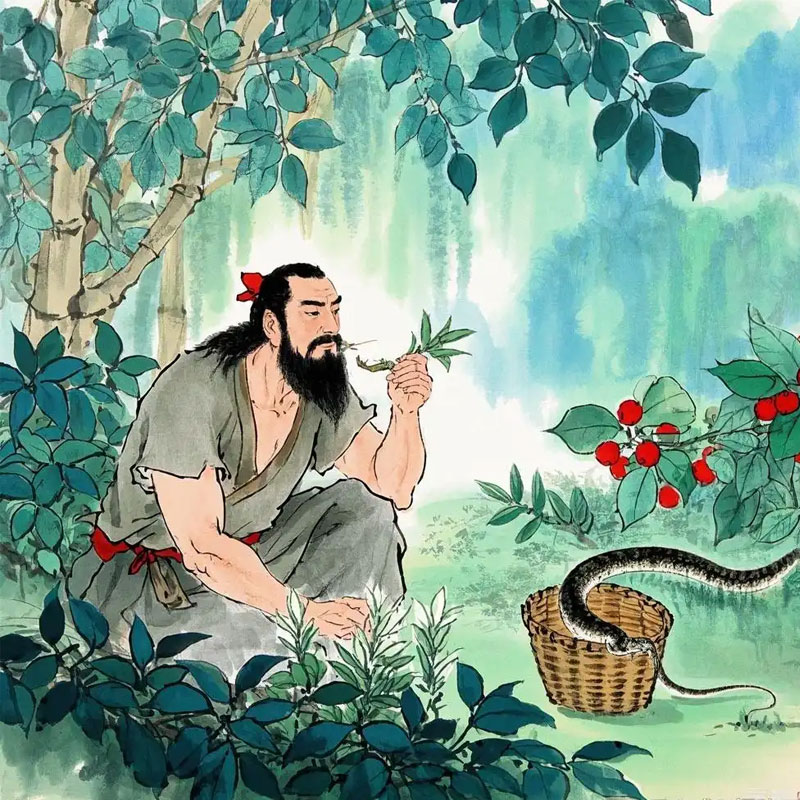
Shennong is the legendary inventor of agriculture and medicine. In remote antiquity, the people lived by gathering, fishing, and hunting. He invented the wooden plow (lei) and the wooden tillage tool (si) and taught the people agricultural production, reflecting the progression of primitive Chinese society from gathering, fishing, and hunting toward farming. It is also said that he tasted hundreds of herbs, discovered medicinal substances, and taught the people how to treat disease.
Following Fuxi, Shennong is another legendary figure who contributed greatly to the Chinese nation. In addition to inventing farming techniques, he also invented medical arts, formulated calendars, and pioneered the water-conservancy technique of interconnecting nine wells. Because he invented agriculture, he was called Shennong (the Divine Farmer). Because he ruled by the virtue of fire, he was also called the Yan Emperor (Flame Emperor), the Red Emperor, and Lie Li Shan Shi — later also becoming a leader who contended with the Yellow Emperor for dominion over all under heaven. For a long time, the question of whether Shennong and the Yan Emperor are the same person has remained unresolved.
Legend has it that Shennong was born with a “crystal belly,” almost completely transparent, through which all his five zang and six fu organs could be seen, as well as everything he ate. At that time, people often fell ill or even lost their lives from eating things indiscriminately. Shennong therefore resolved to taste all the herbs. Those that tasted good he placed in the pouch on the left side of his body, recommending them to others as food or for medicinal use. Those that tasted bad he placed in the pouch on the right side of his body, warning people not to eat them.
Historical Records Concerning Shennong
The Bai Hu Tong Yi · Hao (Comprehensive Discussions in the White Tiger Hall: Titles) states that Shennong was able to accord with the appropriate timing of the heavens and distinguish the advantages of the land. He created agricultural tools such as the plow (lei) and taught the people to till the land, enabling them to obtain great benefits — hence the title Shennong. The Shi Ben · Di Xi Pian (Book of Origins: Chapter on the Imperial Lineage) was the first to link the Yan Emperor and Shennong together, calling them “Yan Emperor Shennong,” asserting that Yan Di was Shennong — Yan Di being the personal title and Shennong the designation. The Han dynasty scholar Gao You, in his commentary on the Huainanzi · Shize Xun, when mentioning the Red Emperor, also merged the Red Emperor with Shennong, saying that the Red Emperor was the Yan Emperor, the son of Shaodian, with the designation Shennong, the Emperor of the South by the virtue of fire. The Zuo Zhuan (Commentary of Zuo), the Guoyu (Discourses of the States), and the Liji (Book of Rites) all mention that Lie Shan Shi was able to sow and cultivate the hundred grains and vegetables. The Eastern Han scholar Zheng Xuan, in his annotations to the Liji, and the Three Kingdoms scholar Wei Zhao, in his annotations to the Guoyu, both state that Lie Shan Shi was the Yan Emperor. The Shui Jing Zhu (Commentary on the Water Classic), Volume 32, further equates Lie Shan Shi with Shennong, recounting that southwest of Miu River, passing south of Li Village, there is a mountain called Lie Mountain. At the foot of the mountain there is a cavern, which tradition holds to be the birthplace of Shennong; thus the Liji calls Shennong “Lie Shan Shi.” As for the origin of the names Lie Shan and Li Shan, there are two theories. The Lu Shi (Grand History) holds that the original character for “Lie” should be “Lie” or “Li,” and because Shennong “traced his origins” to Lie Mountain, he adopted Lie Mountain or Li Mountain as his clan name. Liu Chenghuai, in his Zhongguo Shanggu Shenhua (Ancient Chinese Mythology), argues that the Yan Emperor, as a human deity, burned the mountains with great ferocity, hence the name Lie Shan Shi (Fierce Mountain Clan).
The Shiji · Wudi Benji (Records of the Grand Historian: Basic Annals of the Five Emperors), however, implies that the Yan Emperor and Shennong were not the same person, stating that by the time of the Yellow Emperor, the era of Shennong had already declined. The feudal lords attacked one another and tyrannized the common people, and Shennong was unable to punish them. Thereupon the Yellow Emperor “cultivated virtue and mustered his troops,” punishing the most harmful — the Yan Emperor and Chi You. After vanquishing them both, his prestige soared, and he thus replaced Shennong as ruler of all under heaven. Shennong did not engage in punitive expeditions — this accords with the Zhuangzi · Dao Zhi which says that Shennong “had no heart to harm others,” and the Shang Jun Shu · Hua Ce which says that Shennong “ruled without resorting to punishment or government, and reigned without raising arms or troops.” How then could he have become one who “invaded and attacked the feudal lords, tyrannizing the common people,” as the Yan Emperor is described? The valiant and battle-skilled Yellow Emperor even had to “fight him three times before achieving his aim.” Furthermore, the Shiji · Fengchan Shu (Records of the Grand Historian: Treatise on the Feng and Shan Sacrifices) lists the Yan Emperor and Shennong as two separate persons, and Xu Xusheng, in his Zhongguo Gushi De Chuanshuo Shidai (The Legendary Age of Ancient Chinese History), also maintains that the Yan Emperor and Shennong were two distinct figures.
Why did Shennong conceive the idea of planting the five grains? The Bai Hu Tong Yi records: “The people of antiquity all ate the flesh of birds and beasts. By the time of Shennong, the people had become numerous, and birds and beasts were insufficient. Therefore Shennong, following the seasons of heaven and distinguishing the advantages of the land, fashioned the plow and tillage tools, taught the people to labor, and transformed them through his spirit, making their lives easier. Hence he was called Shennong.” This indicates that the era of Shennong was a crucial turning point in China's transition from primitive animal husbandry to primitive agriculture. At that time, the population had already grown large, and their sustenance depended on hunted game and gathered fruits and seeds. Yet the birds in the sky grew fewer with each hunt, and the beasts on the ground grew sparser, until the food obtained could no longer fill their stomachs. How could the people's food problem be solved? Shennong pondered this bitterly, racking his brains.
According to the Shi Yi Ji (Records of Gleanings), one day, a bird entirely covered in crimson feathers, carrying a stalk of multicolored nine-eared grain in its beak, flew across the sky. As it passed over Shennong's head, the nine-eared grain stalk fell to the ground. Shennong saw it, picked it up, and buried it in the soil. Later, it grew into an entire field. He rubbed the ears of grain in his hands and placed the kernels in his mouth, finding them delicious. He then taught people to fell trees, clear wild grasses, and use axes, hoes, plows, and other production tools to open up the land and plant grain.
From this, Shennong drew inspiration: grain could be planted year after year in a continuous, unending supply. If more plants and fruits could be selected for human use and planted in large quantities, would not the problem of feeding everyone be solved? At that time, the five grains grew together with weeds, and medicinal herbs bloomed among the hundred flowers. No one could distinguish which could be eaten and which could not. Shennong tasted them one by one and trial-planted them one by one, finally selecting from among them the five grains: soybean (shu), wheat (mai), millet (ji), rice (dao), and broomcorn millet (shu). For this reason, later generations honored him as “Lord of the Five Grains” and “Lord Farmer Emperor.”
After teaching the people to plant the five grains, Shennong did not simply rely on heaven for the harvest. He also taught the people to dig wells and draw water to irrigate their crops. On a certain high platform, there was a well at each of its four corners and one at the center; the water in all the wells would ripple in unison. Because this area has been repeatedly inundated by the Yellow River throughout history, with massive deposits of silt left behind when the waters receded, most of these wells have been buried underground. Only one has been found today, located two hundred paces to the south. The water of this well is clear and sweet, and every day people from up to a hundred li around come to fetch water here, calling it “divine water” and claiming it can directly cure disease.
To commemorate Shennong's great achievements in tasting the hundred herbs and planting the five grains, later generations built temples on this high platform. Tradition holds that Shennong was born on the fifth day of the first lunar month, so sacrificial rites are performed from the fifth to the twentieth of the first month each year, praying for an abundant harvest of the five grains. Throughout the dynasties, high officials, noblemen, scholars, and literati came here in droves to pay homage. According to county records, during the Three Kingdoms period, Cao Zhi, after visiting and paying his respects, wrote the famous “Ode to Shennong”: “Descendant of Shaodian, by the virtue of fire he completed the wood. He created the plow and tillage, guiding the people to sow the grains. He set right the elegant qin zither, to enrich and harmonize the customs...”
The statue of Shennong on the Five-Grain Platform depicts him with leaves draped over his shoulders, double horns emerging from his head, and the five grains held in his hands. The murals on the walls record the main achievements of his life: besides opening up wasteland, tasting the hundred herbs, sowing the five grains, and drawing water for irrigation, he also established the midday market, invented pottery, and tasted herbs to cure disease.
With the advent of agriculture and the resulting surplus of the fruits of human labor, Shennong established marketplaces, allowing everyone to bring surplus food and goods that they could not consume or use and exchange them at the market every midday — thus giving rise to China's original, primitive commodity trading.
At the same time, he also invented pottery, solving the problem of human life utensils — vessels, clay basins, clay jars, and the like.
Another great achievement of Shennong was the founding of Chinese medicine and medical arts.
The Gang Jian Yi Zhi Lu (Records for Easy Perusal of the Outline and Mirror) records: “The people had diseases but knew nothing of medicinal herbs. The Yan Emperor first tasted the flavors of plants, discerning their cold, warm, neutral, and hot natures, and distinguishing the principles of sovereign, minister, assistant, and envoy. He tasted a single mouthful and encountered seventy poisons. Through his divine transformation, he then wrote texts to treat the people's illnesses, and thus the medical way began.”
Appendix: The Legend of Shennong Tasting the Hundred Herbs
In high antiquity, the five grains grew mingled with weeds, and medicinal herbs bloomed among the hundred flowers. No one could distinguish which grains could be eaten and which herbs could cure disease. The common people lived by hunting — but the birds in the sky grew ever fewer, and the beasts on the ground grew ever sparser, until people were left with nothing but empty stomachs. If anyone developed sores or fell ill, with no doctors and no medicine, even if they did not die, they would at least be skinned alive!
The sufferings of the common people — Shennong saw them with his own eyes, and the pain gnawed at his heart. How could the people be fed? How could they be cured? Shennong pondered this bitterly for three whole days and nights, and at last an idea came to him.
On the fourth day, leading a band of his subjects, he set out from his homeland at Mount Li in Suizhou and headed toward the great mountains to the northwest. They walked and walked — their legs grew swollen, their feet became calloused — yet still they did not stop. They walked for a full seven-times-seven, forty-nine days, and arrived at a certain place. There they saw mountains, peak upon peak, and gorges, ravine after ravine. The mountains were covered with exotic flowers and rare herbs, whose fragrance could be smelled from a great distance. As Shennong and his group pressed forward, suddenly a pack of wolves, insects, tigers, and leopards burst from the gorge and surrounded them tightly. Shennong at once ordered his subjects to brandish the divine whip and strike at the wild beasts. They beat off one wave, only for another to surge forward, and they fought for seven days and seven nights before finally driving all the wild animals away. The tigers, leopards, pythons, and snakes were left with stripes and welts where the divine whip had lashed them — stripes that later became the markings on their skins.
At this point, his subjects said the place was too dangerous and urged Shennong to turn back. Shennong shook his head: “We cannot go back! The common people are starving with nothing to eat, and falling ill with no one to heal them — how can we return?” So saying, he led the way into the gorge, arriving at the foot of a vast, towering mountain.
This mountain was half buried in the clouds, with cliffs sheer as if sliced by a knife on all four sides. Waterfalls hung from the cliffs, which were covered in slippery green moss, glossy and slick. It seemed that without a ladder reaching to the heavens, there was no way to ascend. His subjects again urged him to give up and return while they still could. Shennong shook his head: “We cannot go back! The common people are starving with nothing to eat, and falling ill with no one to heal them — how can we return?” Standing on a small rocky peak, facing the great mountain, he gazed up, looked down, peered left, and squinted right, searching for a plan, thinking of a way. Later, people named this small peak where he stood “Pavilion of Longing for the Farmer” (Wang Nong Ting). Then he noticed several golden monkeys climbing across by following the ancient vines hanging from on high and the rotting logs lying across the cliff face. An idea struck Shennong — he had it! He immediately summoned his subjects and ordered them to cut wooden poles and strip vines. Leaning them against the cliff face, they built scaffolding, adding one layer each day. They built from spring to summer, from autumn to winter, regardless of wind and rain, or flying snow and freezing ice, never stopping work. They built for a full year, erecting three hundred and sixty layers, before finally reaching the summit. Tradition says that the scaffolding later used by people to construct buildings was learned from Shennong's method.
Shennong led his subjects as they climbed the wooden scaffolding and reached the summit. Ah! The mountaintop was truly a world of flowers and plants — red, green, white, yellow, of every kind and color, in dense, thick profusion. Shennong was overjoyed. He ordered his subjects to guard against wolves and beasts while he personally plucked the flowers and plants and placed them in his mouth to taste them. In order to taste the hundred herbs there, to find food and medicine for the common people, Shennong had his subjects plant several rows of fir trees on the mountain as a living wall to keep out wild animals, and build thatched huts within the wall to dwell in. Later, people called the place where Shennong lived “Wooden Fortress” (Mu Cheng).
